Showing posts with label Zurich 1953. Show all posts

Saturday, October 24, 2009

Zurich 1953: Vasily Smyslov, A night at the Opera with the Winner

Vasily Smylsov was born March 24, 1921 in Moscow and learned to play chess from his father at the age of 6. His father was a good player. That and his father’s library created the foundation of this contender. He was a tenor opera singer. Had it not been for his narrowly failing an audition for the Bolshoi Opera in 1950, he might never had made it to Zurich 1953. He once said, “ I have always lived between chess and music”. He once sang operatic extracts on Swiss radio and during the interval of a serious chess game against Botvinnik he sang to an audience of thousands.

In 1938, at 17, he showed some promise as he won the USSR Junior Championship and tied for 1st and 2nd place in the Moscow city Championship. During WWII, international tournaments were very limited. He placed 3rd in the 1940 USSR Championship ahead of Botvinnik. . He won the 1942 Moscow Championship and finished strong in several other regional events.

Despite hitting a post war slump between the period of 1945 -46 with up and comers like Bronstein, Keres and Botvinnik at his heels, his earlier results earned him a place in the Howard Staunton memorial in August of 1946. He finished in third place. For the next couple of years, his results showed a consistent pattern of high finishes against strong company, but with virtually no tournament championships. Smyslov had never actually won an adult tournament other than the Moscow City Championship, before he played in the 1948 World Championship Tournament.

How did he get to Zurch?

Smyslov was one of the five players selected to compete for the 1948 World Chess Championship tournament to determine who should succeed the late Alexander Alekhine as champion. His selection was questioned in some quarters, but this criticism was amply rebutted when he finished second behind Mikhail Botvinnik, with a score of 11/20.

Finishing second seeded him in the 1950 Budapest Candidates Tournament but finished behind Bronstein and Boleslavsky. FIDE granted him the International Grandmaster title in 1950 on its inaugural list.

The third place finish in 1950 seeded him into the 1953 Candidates match in Zurich. To recap, he was a pretty good player back in a day under local competition, showed that he could fight like the big guns in international play though not quite a first place finish, could make the opera, and was a freshly minted GM in 1950 seeded into both cycles of candidates matches.

Enter Zurich 1953. After his win against Euwe in round 3, he takes an early lead in the match. This game was a pendulum swinging back and forth. Smyslov played the black side of a Grunfeld and forced Euwe into an IQP dynamic. Euwe had a lot of theoretical preparation for the line and moves ahead with marching the d-pawn. Euwe follows up with an exchange sacrifice that gives him a couple of passed pawns, one being very advanced. Smyslov finds the move that underscores the very weakness of the advanced pawn on d6. In a resourceful maneuver, Euwe attempts a decoy to draw the rook away. Finally, Smyslov accurate play leaves Euwe with a slight inaccuracy that allows Black to come hammering down on the material. He defeats Euwe in both occurrences in this match ( again in round 18). This was the confidence builder he needed. In contrast to the Howard Staunton Memorial where he finished behind the former World Champion, this was the boost he needed.

By round 8, the American was taking the lead. The expectation in round 10 was to see a huge battle. Instead, both players were more into reconnaissance of the other players and saving their major battle for the second have. Indeed, by round 25, Smyslov was leading by ½ a point. Reshevsky needed the win. Smyslov had White and opens with the Reti, which REshevsky had a prepared line that pitched his knights against the Bishop pair. The middle game was a heated dance with neither side conceding to a draw. Then , on move 33, Smyslov plays Rc2 because it prepares a battery on the long diagonal and opens the position up in favor of White.

Prior to this round, Smyslov faces off with Keres in round 24. Keres, with white, launches a strong rook attack on Smyslov’s king side. Had he made a couple more supportive moves ( blocking the Balck King’s escape) he might have actually gotten the point. Smyslov sees through Keres’ rook sacrifice and passes on it to play a more accurate move that opens up the diagonal, the d-file, and strong points in the center. In the first half of the tournament, in round 9, Smyslov put Keres under cross fire in an inferior QGD.

His victory in Rounds 24 and 25 cinched the victory as he entered round 26 a full pont nad a half ahead of Reshevsky. By round 27 he maintains a 2 point lead only to shrink ny ½ point in one round by Bronstein in round 28. On October 23, 1953, he finished round 30 with 18 points in a clear 2 points ahead of Bronstein, Keres and Reshevsky.

Epilogue:

Following the Candidates match, he faced Botvinnik. After 24 games ending in a drawn match, Botvinnik retained his title. The next interzonal cycle had him seeded once again for the 1956 Candidates Match in Amsterdam. He won that match again with another shot at the World Champion. Assisted by trainers Vladimir Makogonov and Vladimir Simagin, Smyslov won by the score 12.5-9.5. The following year, Botvinnik exercised his right to a rematch, and won the title back with a final score of 12.5-10.5. Smyslov later said his health suffered during the return match, as he came down with pneumonia, but he also acknowledged that Botvinnik had prepared very thoroughly.[2]Over the course of the three World Championship matches, Smyslov had won 18 games to Botvinnik's 17 (with 34 draws), and yet he was only champion for a year.

Smyslov continued to play in other World Championship Qualifiers though he never ended up qualifying for another World Championship. Even at the age of 62, he played in the Candidates Final in 1982. He lost to Gary Kasparov who went on to defeat Karpov, the World Champion at that time.

End notes:
This concludes my biographical study on this historic series on the Zurich 1953 Candidates match. Right now I will park the Delorean and tune her up for my next journey. The time machine is being calibrated for the late 1970’s. Stay tuned to see where I land next.

Sunday, October 18, 2009

Zurich 1953: David Bronstein, Attack with Defense


David Ionovich Bronstein was born on February 19, 1924 in Bila Tserkva (near Kiev) in Ukraine. He learned to play chess at the age of six from his grandfather. He was trained by an International Master, Alexander Konstantinopolsky as a youth. At age 15, he came in second place at the Kiev championship. He earned a Master’s title at age 16.

Upon graduating high school, WWII broke out and interrupted his plans to study Mathematics at Kiev University. After the war, he attended Leningrad Polytechnical Institute for one year. Chess took precedent over his studies. In 1944, he defeated the Soviet Champion, Mikhail Botvinnik at the USSR Championship. This launched him into playing on the Soviet team during the famous 1945 USSR versus USA Radio Chess Match.

It was during the 1948 interzonals in Saltsjobaden where he won the tournament that earned him a grandmaster title. The win earned him a spot in the 1950’s Candidates match in Budapest. His best friend, Boleslavsky and David both won the match and had to endure a play off. He beat Boleslavsky and went on to contest Botvinnik for the Championship. The Moscow World Championship Match in 1951 ended in a draw ( 12-12) and Botvinnik retained the title. He came real close to taking the title leading by a full point by game 22. Speculation about Bronstein being forced to lose the match was rumored. He was quoted as saying ( in his book, The Sorcerer’s Apprentice:
"I have been asked many, many times if I was obliged to lose the 23rd game and if there was a conspiracy against me to stop me from taking Botvinnik's title. A lot of nonsense has been written about this. The only thing that I am prepared to say about all this controversy is that I was subjected to strong psychological pressure from various origins and it was entirely up to me to yield to that pressure or not."
And a little further in the book:
“I had reasons not to become the World Champion, as in those times such a title
meant that you were entering an official world of chess bureaucracy with many
formal obligations. Such a position is not compatible with my character.”
In any case, his results in 1951 entitled him as a seed into the candidates match here in Zurich 1953.

I’ll cut to the chase. In the previous post I mentioned about the conspiracies lurking at Zurich. In round 12 , we have Paul Keres as Black against Bronstein. Move 5 is suspect as well as further along when Keres willingly exchanges his strong king side defender, the dark squared bishop, and pretty much hands Bronstein the game. The comment Bronstein makes on this move is “ a little too straightforward, an opinion Black soon comes to share himself.”, is a little revealing in a subtle way.


It is move 14..Bd4+ which forces the exchange and allows White to dominate the king side that I find most suspect. Bronstein’s previous quote about chess bureaucracy may have resonated with Keres here. By round 12, the fix was in for either Bronstein or Smyslov to take down the American, Reshevsky.

Going into round 13, Reshevsky was undefeated and in the lead a full point and a ½. Bronstein was under extreme pressure to WIN. Bronstein plays the King’s Indian as black, a strong defense and very well theorized by the author. It starts down a common KID with lots of maneuvering. Reshevsky tries to cash in on an initiative in the center preparing an exchange sacrifice with a mating combination. Instead, Bronstein exchanges off the strongest attacker, the knight. After the dust settles, Reshevsky offers a draw but Bronstein brings it home with a very sharp and instructional Queen versus opposite bishops endgame. At a tense moment, both sides were avoiding queen exchanges due to mutual annihilation. It ends with White being Zugzwanged. This win closed the gap to only ½ point difference between Reshevsky and him.


They meet again in round 28. By this time, Smyslov was in clear first place with 16 points and Reshevsky and Bronstein were even with 14 ½ points. The heat was still on. They go into a main line Ruy Lopez 18 moves before Bronstein takes the first detour. He plays 18 g3 to prevent Black from landing on f3 with a knight. The middle game then struggled around White preventing black from landing his knight on d3 while trying to land his own on d5. Reshevsky offered draws on several occasions as time pressure loomed. Bronstein plays a trap against the American under time pressure and it works. Black was forced to give up the exchange ( rook) or face being mated.


These three games were the highlight of the drama and tensions felt at the Zurich event. I’d like to point out one of the other nice wins that has some technical merit. His first round win against Taimanov was a nice Benoni with a queen side attack with Bronstein playing a pawn sacrifice in the opening. The b5 line undermined White’s d5 advance and opened the a- and b-files for a marauding raid on the queenside.

Epilog:


The concession of placing second was to write the epic tournament book that is still instructional today. He qualified for the 1955 Goteborg Interzonals and landed a another near miss at the Candidates match in 1956 Amsterdam where he tied for third through seventh place behind runner up Keres and winner Smyslov. He had to Qualify for the 1958 Interzonal in Portoroz but didn’t make it to the candidates match in 1959 by ½ point. He missed the next round of zonal qualifiers in 1962 as well.

Bronstein was also a six times winner of the Moscow Championships, and represented the USSR at the Olympiads of 1952, 1954, 1956 and 1958, winning board prizes at each of them, and losing just one of his 49 games in those events. Along the way he won four Olympiad team gold medals. In the 1954 team match against the USA (held in New York), Bronstein scored an almost unheard-of sweep at this level of play, winning all four of his games on second board.

He had successes in other international events like Hastings 1953-54, Belgrade 1954, Gotha 1957, Moscow 1959, Szombathely 1966, East Berlin 1968, Dnepropetrovsk 1970, Sarajevo 1971, Sandomierz 1976, Iwonicz Zdrój 1976, Budapest 1977, and Jūrmala 1978.

His greatest legacy in my opinion was in his books. Zurich International Chess Tournament 1953 reached the largest circulation and he continued to write until his 70’s with The Sorcerer’s Apprentice being an autobiographical section along with games that amplify the ideas behind the player’s moves. His work gives insight to a romantic vision of chess.

His contributions to several openings extends this legacy with special regards to his work on the king’s Indian defense.

Bronstein was a chess visionary. He was an early advocate of speeding up competitive chess, and introduced a digital chess clock which adds a small time increment for each move made, a variant of which has become very popular in recent years. ICC wouldn’t have some of the time limits today had it not been for this genius.

He was married three times. His first wife was Olga Ignatieva, a Soviet woman International Master, and they had one son. Little is know about his second wife Marina Viktorovna. He was divorced in the mid 1960’s. Then, in 1984, he married Tatiana Boleslavsky, the daughter of best friend GM Isaac Boleslavsky.

His health was in decline in his last couple of years, suffering from high blood pressure. He died on December 5, 2006 in Minsk, in the arms of his wife Tatiana.

“I still wonder why people in general have respect only for world champions and not for all chess players,” he wrote. “Is it not clear that we all play the same game of chess?”

Sunday, October 04, 2009

Zurich 1953: Possible Conspiracies and Controversies.


In my previous post on Paul Keres, I made a reference to some controversy about game fixing at the Zurich 1953. A couple of readers posted comments and links to articles that seemed to substantiate more behind the scenes activities around this. I felt remiss in not elaborating early. This was in part by my attempt to keeping the perspective to just the games and the brief biographies of the players. This didn’t provide the correct vantage point. It is like peering through a key hole to watch a parade. I thought I’d use this post to climb up on top of the rook and attempt to provide some perspective on the topic of Soviet domination in chess, the Cold War, and the KGB, from still a limited perspective.

Background: the rise of Soviet Dominance in Chess ( 1920’s through late 1940’s)

First, I’d like to point to an article that appeared recently in the Slate: http://www.slate.com/id/2229515/ . Christopher Beam’s article, titled, Red Squares, Why are the Russians so good at chess? Postulates that since the Bolshevik revolution, it became a national pastime that was subsidized. Vladimir Lenin’s supreme commander of the Soviet Army, Nikolay Krylenko, laid the foundations for state sponsored chess. This opened the doors to chess schools and state run tournaments. It was promoted as a vehicle for international dominance. Alekhine was the first Russian to win a world championship.

At this time, FIDE used a complicated “London Rule” to determine the Champion ( per request of Capablanca). That being: the first player to win 6 games would win the match and the former champion would have a year to defend his title. In addition to this, the challenger had to raise $10,000 for prize money. The Soviet union refused to join FIDE mainly because of the financial requirements for the world championship matches. Had it not been for an Argentina businessman backing Alekhine, the match would never havee occurred. But in 1927, Alexander did manage to defend Jose Capablanca for the title and changes were being put in place on the conditions for future challengers.

Without getting into too much further mud with the FIDE’s changing landscape over the debate of determining challengers either by commission or the Dutch proposal, I’d rather focus on what the soviets were proposing. The Dutch solution, the AVRO 1938 tournament, brought together the best players in the world. Paul Keres won this on a tie break against the American, Reubin Fine. Mikhail Botvinik came in third. Botvinik challenged Alekhine for the World championship immediately following the 1938 tournament. Keres also challenged the world champion and both had the $10,000 prize fund. The problem was World War II broke out. Estonia was in a tug of war with German-Nazi occupation for a period and then back the USSR by the end of the war. Negotiations with Botvinik were sustained but Keres was prevented by the Soviets on the grounds that he had collaborated with the Germans during their occupation of Estonia. ( he played in a tournament while under German occupation). Ultimately, Capablanca’s challenge to the title was accepted and the rival’s were to play in Buenos- Aires in 1940. They never got a chance to play the match due to travel restrictions during WWII.

As for Keres, keep in mind the severity of the Stalinism and ideologies of the Cold War. In WWII, Red Army soldiers, if captured by the Germans and later freed, would often be shot by their own army on grounds of ideological contamination. Now, Keres was neither a soldier or a defector. Playing in Nazi-organized tournaments while Estonia was under German occupation and later suspected him of assisting anti-Soviet Estonian Patriots definitely clouded Paul’s ability to challenge the World title. By virtue of AVRO 1938, he had the right to challenge Alekhine for the World title. With Estonia now back under USSR control, Keres had to stand aside while his country man, Botvinnik, challenged the World Champion ( despite placing third in AVRO).

FIDE’s decision to allow the match with Capablanca (though they never played) did not bode well with a country who’s national pastime was sense of pride. Following the War and shortly after, Alekhine’s death, a interregnum made the normal procedure of challenger versus contender impossible. Problems with money and travel checkered FIDE’s decisions on how to proceed. The Soviet Union realized it could not afford to be left out of the discussions about the vacant world championship, and in 1947 sent a telegram apologizing for the absence of Soviet representatives and requesting that the USSR be represented in future FIDE Committees.

The people’s hero: Mikhail Botvinnik:


As the USSR joined the discussion, Mikhail Botvinik put a proposal based on the 1938 AVRO tournament with the omissions of the late Alekhine and Capablanca dignitaries. The proposal ended up defining the three year cycle which the challengers to the World Champion would be selected. The 1948 world championship match ended up being a five player quintuple round robin event with the following players: Max Euwe (from Holland); Mikhail Botvinnik, Paul Keres and Salo Flohr (from the Soviet Union); and Reuben Fine and Samuel Reshevsky (from the United States). But FIDE soon accepted a Soviet request to substitute Vasily Smyslov for Flohr, and Fine dropped out in order to continue his degree studies in psychiatry. Botvinik won the title in 1948, and kicked off an era of Soviet domination.

Taylor Kingston is a historian who has several articles with Chess Café. http://www.chesscafe.com/text/skittles165.pdf His article: The Keres-Botvinnik Case Revisted: A further Survey of the Evidence points to the +4 -1 score against Keres, his best opponent and previous winner at AVRO, to be suspect of falling prey to the oppressive Stalin regime. Botvinnik was becoming an acceptable icon of Soviet Culture.

Though he agrees that no real smoking gun came from the KGB files follwoign the fall of the USSR, looking at the games really was inconclusive due to mixed results from several strong players ( Hans Ree, Jan Timman, Larry Evans, John Watson and John Nunn). Taylor points more in the direction of the politics in the day. To allow Keres to win the 1948 championship is “comparable to a Mormon becoming Pope” and may hold the key to the evidence of coercion. He cites that the Soviets may have motive and opportunity, ultimately lack of proof makes this argument more speculative.

The article references a few other historians. One by Valter Heuer, who was a friend of Keres examines Keres’ WWII postwar situation through 1948. Though Keres had to sustain many hardships and distractions, they were not construed as deliberate Soviet Policy to help Botvinnik. Another was Ken Whyld who know Keres basically claims that he was not ordered to lose the games but the emphasis was on that if Botvinnik failed, it was not Keres’ fault.


In an interview with Botvinnik, he comes out and says that the orders for Smyslov and Keres to lose came directly from Stalin himself during the second half of the match. Botvinnik then went on to state that he found the proposal insulting and refused.

To recap thus far: FIDE’s World Championship title was up in the air following the death of Alekhine in 1946. Having boycotted FIDE under principles of the London Rules not a true invitation for true challengers unless they were backed by beneficiaries, decides to chime in on how the championship should be won and has their architect win it!

Bronstein and Boleslavsky duke it out in the next cycle to challenge Botvinik. Bronstein draws the match against Botvinnik. Because drawn matches go to the defender, Botvinnik retains the title.

What really went down in Zurich 1953?

With 5 years into the Soviet architected FIDE championship cycle matches, we arrive at Zurich. This was also the same year that Stalin had died and the arrest and execution of Lavrenti Beria and others connected to the KGB. Bronstein’s second was not allowed to travel to Switzerland because he was an officer in the secret police. So the atmosphere was politically charged.

With the Cold War also in full swing, 9 soviets were represented in the Candidates match out of a field of 15 to insure the World Championship title be held by the USSR. By round 11, Reshevsky, the American, was leading the tournament. In the book, The Sorcerer’s Apprentice, Bronstein claims he was under pressure by heads of the USSR delegation and ordered him to win. Reshevsky was not to be allowed to advance . In my next post I will comment on this 13th round game that became a positional masterpiece.

The second half of the tournament Smyslov was leading by one point over Bronstein and Reshevsky. Keres was catching up. The Soviet’s delegates ordered physicals for Keres, Bronstein and Smyslov at this point and concluded that Smyslov was weakened and wouldn’t make it to round 30. In short, a lot of draws were seen in the middle rounds so that by round 22 Reshevsky and Smyslov were tied with 13 ½ points followed by Bronstein with 12 ½ and Keres with 12.

Reshevsky lost to Kotov in Round 23. This was gave the Soviets a slight break since Smyslov had a bye that day. It allowed Bronstein and Keres to move up to 13 points. Round 24, Keres had white against Smyslov. In the Tournament book, Bronstein only makes the comment that Keres was motivated by “psychological circumstances” in taking a risky Kingside attack.

Later, Bronstein in a 64 article, describes the struggle the Keres was under. Before the round, the KGB tried to convince him to make a draw with White against Smyslov so that he could use his strength against reshevsky in round 25. Keres lost ( game will be highlighted in a later post on Smyslov).

In round 24 Bronstein was also approached by the delegates and was told that Geller was asked to throw his game against Bronstein to insure his standings. Bronstein tried to protest but decided to play for a draw instead. Bronstein ended up losing to Geller.
The KGB thought it was Geller’s strong will to defy them and suggested to Bronstein to make a quick draw with Smyslov even having a conversation with him prior to the game.


A lot of this is one person’s word over most probable speculations. With out definitive proof, it's hard to reveal this without a shadow of doubt. It definitely adds to the color of the games played in Zurich 1953.

Sunday, September 13, 2009

Zurich 1953: Samuel Reshevsky, A child Prodigy grows up.


Paul Morphy was probably the first documented Chess Prodigy as he came of age in the Mid 1800’s . Half a century later it was Jose Raul Capablanca and not so well known Richard Reti. Born, November 26th, 1911 near Poland, Samuel Reshevsky learned to play at age 4, and by the time he was eight, he was beating masters and giving simultaneous exhibitions. His parents moved to the United States in 1920 so they could exploit his skills and make a living off an child’s simultaneous exhibitions. This made him the first chess prodigy from the USA since the days of Paul Morphy.

It’s no surprise that he went on to win several U.S Championships ( 1936, 1938, 1940-42, 1946) before playing at Zurich. He was not considered a professional chess player as an adult since he temporarily gave it up to attend college at the University of Chicago with an Accounting degree. He support himself and his family by working as an accountant. He married Norma Mindick and had three children.

He was seeded into the Zurich 1953 Candidates Match. He finished in Third place during the World Championship match competition in 1948. He was invited to the Budapest Candidates match in 1950, but because of the Cold war, the US refused to send him.( rumored and in an interview in 1991, Reshevsky claims the decision was his, though other NATO country players like Euwe, didn’t play) He was titled GM in 1951. His previous status and new title gave him a seat in Zurich 1953.

Let’s look at some of his Zurich 1953 games. Round 4 has Szabo attempting the Grunfeld Gambit. The game starts down a safe line of the Grunfeld until Szabo attempts the Grunfeld gambit. Reshevsky declines the offer but Szabo pushes and sacrifices both center pawns to keep White's King side undeveloped. Black's threats are too tame given the material loss. This allows Reshevsky to defend rather well. Szabo misplays the middle game where he should have exchanged bishops and get a rook to c8. A combination in the end forces an exchange of queens. This leaves White with too much material for Black to defend.

In Round 5, Reshevsky plays Black against Euwe. Euwe initially missed playing e4 early in the game which would have given him an attack. This gave Reshevsky a chance to recoil with a strong attack on the a8-h1 diagonal with a Bishop and Queen battery. White dodges the strong mate threat but it costs him hanging pawns and misplaced minor pieces. Black breaks through on the c-file. White's last ditch effort attempts a run for queen but too much material was lost.

In round 6, on a streak, he is paired against Stahlberg in a relentless pursuit of the center. The game starts down the path of a Tarrasch Variation of the QGD. Taken a little further down the path of the Swedish Variation makes Black target a Queenside pawn majority. Reshevsky takes immediate aim on the center and Black's pawn chain. White is relentless on the attacks and makes a series of forcing moves while inching his d-pawn closer to the eighth rank. Black chokes and gives up one of the queen side pawns despite Reshevsky being under time pressure.
After winning three games in a row, he draws in round 7 against Bolesavsky but picks it back up again in round 8 with nail biter with seconds left on Reshevsky’s clock avoiding a swindle from Kotov. The game starts down an old Indian defense but quickly turns into a King’s Indian defense. Black supports and puts pressure on d5 while White focuses on e5. White then pushes b pawn, putting more pressure on the Black center. Reshevsky trades off the good bishop for Black's bad bishop. Doing so, he immobilizes Black's knight on c8. Now, under time pressure, Kotov slings a last ditch swindle effort But Reshevsky keeps his cool and snaps up a piece with check instead. A note about Reshevsky’s time pressures, in his own words:

"By playing slowly during the early phases of a game I am able to grasp the basic requirements of each position. Then, despite being in time pressure, I have no difficulty in finding the best continuation. Incidentally, it is an odd fact that more often than not it is my opponent who gets the jitters when I am compelled to make these hurried moves."

His streak stalls mid tournament with a string of draws coupled with a few losses. He comes back towards the later half in round 18 with Averbakh. Bronstein flames Averbakh for not playing an early c5 in the Nimzo-Indian. Instead, Averbakh choses a solid but passive line in the Nimzo-Inidan and gets a false sense of security with rote strategy. This allows Reshevsky to take his time to build a strong center and acheives d4 and e4. Then, he begins a king side attack by first weakening the pawns around it, followed by the battering ram on the h-file. Again, under time pressure. Bronstein felt that Averbakh could have at least created better complications later in the game with counter attacks on the queen side. Reshevsky felt that this was his best game of the tournament.

In round 22, against Boleslavsky’s King’s Indian defense, Reshevsky takes the more complicated Fianchetto variation and creates complications. Bronstein gets rather poetic with this game and states:
"Chess is a limitless game; to avoid losing his way in it, the chess player will use certain guideposts to orient himself in the evaluation of a position and the selection of a plan, such as weak pawns, open files, a lead in development, good and bad bishop, a poorly placed king, and so on." ( he goes on at length but to get to his point for this game Bronstein continues: ) "It is worth noting that one will not find in every game such guideposts as will allow one to compare a position's good and bad points and to choose a proper plan on that basis....In any event, one frequently finds the sort of game which must be played for quite some time on nothing more than gut feeling and calculation."
Again, Reshevsky was under tremendous time trouble, yet again, he takes on a complication that leaves him with a point.
Finally, in round 29, I will point to the game against Gligoric in which Gligoric gives Reshevsky a chance to regroup. He plays a Slav variation of the King's Indian and even plays an early c5 targeting the Reshevsky’s White pawn center before it has a chance to reach critical mass. Reshevsky plays cautiously and allows Gligoric to gain some space on the Queen's side. Playing to win d5 and getting a little impatient ( according to Bronstein), Gligoric hands Reshevsky the a1-h8 diagonal which he exploits rapidly. Again, under time pressure, Reshevsky missed a cleaner solution to the end. He still managed to win.

A little about the “self entitlement” persona given by the former Prodigy:

In the book, Bronstein comments about the Kotov game and the time pressure moments. Reshevsky blurts out “ How many moves do I have to go to make the first time control?” This is regarded as highly illegal under tournament rules and to top it off, a spectator responds. The event goes without any violations being claimed. It may have been because one of the games was played late at night to accommodate Reshevsky’s strict orthodox Jewish Observations about playing during the rise of the evening star. His Friday games had to be played during the day so as to finish before the rise of that star. Then, on Saturday, he started his games several hours after the other games after the rise of the evening star.
I hear anecdotal remarks about Reshevsky’s sharp sense of entitlement in the chess world. One has him asking a tournament official to disqualify Bent Larsen because he continued to play a game for a win after they agreed before the start to conclude with a draw.
I’m not sure of how many of these are true or embellishments. Having been a prodigy at such an early age, psychological studies on such prodigies reveals that there is a threshold they reach as adults once their peers “catch up”. After being the center of attention for so long, some can’t make the transition smoothly ( Fischer for one, Morphy may have been another). Add to that the notion that his parents moved to the USA when he was eight to pretty much put him on display like a freak. I don’t know, but that alone has got to mess up a kid. That’s my unsolicited opinion. My apologies to bring this into the essay for Reshevsky.

Epilog:
During his long chess career, Reshevsky played eleven of the first twelve World Champions, from Emanuel Lasker to Anatoly Karpov, the only player to do so (he met Garry Kasparov but never played him). He defeated seven World Champions: Lasker, Jose Raul Capablanca, Alexander Alekhine, Max Euwe, Mikhail Botvinnik, Vasily Smyslov, and Bobby Fischer.
Besides playing is several U. S. Championships and the US team for the Chess Olympiads, following Zurich 1953, Reshevsky won some important tournament titles at events in New York 1956 (Lessing Rosenwald Trophy), Dallas 1957, Haifa/Tel Aviv 1958, Buenos Aires 1960, Netanya 1969, and the Reykjavík Open 1984 at age 72.

His legacy includes a few books: Reshevsky on Chess ( 1948), How Chess Games Are Won (1962), Great Chess Upsets (1976), and The Art of Positional Play (1978). He also wrote a book on the 1972 World Championship match between his great rival Bobby Fischer and Boris Spassky. He authored columns in chess magazines and The New York Times.

Reshevsky died at the age of 80 in New York on April 4, 1992

Wednesday, September 02, 2009

Zurich 1953: Tigran Petrosian, The "Iron Tiger".


Born in Tbilisi, Georgia ( USSR) on June 17, 1929, made him 24 at the time of the candidates match of Zurich in 1953. He learned the came of chess at eight after entering a local chess school in his home town.

He had some impressive results at the age of 16, when he shared 1st-3rd place at the 4th USSR Junior championship at Leningrad in 1945. A year following, Petrosian won the title of Armenian Champion. At 17 he was already competing for candidates matches but didn’t quite make it in the big leagues until he moved to Moscow in 1949. In 1951 he won the Moscow tournament. In 1952, he was titled international Gandmaster and also got married to Rona Yakovlevna Avinezar.

He earned his nickname “Iron Tiger” because of his reputation of having impenetrable defenses which guaranteed safety above all else. This is most obvious in his solid and cautious style of play at Zurich. In round 9 against, Szabo, he plays a solid Orthodox QGD Tartakower variation. He slowly builds up a solid center and baits White with two central pawns. This causes white to exchange on the wrong square leaving white with a weakened knight and dark squares. The Tiger pounces as he builds a huge canon on the c-file and eats one of White’s pieces.

With white against. Euwe in round 10, he plays the Reti. Instead of playing to control c4, Petrosian shifts gear and focuses on e4. Euwe plays overly cautious and passive. This allows White to gain control of the center and, in particular, the d-file. After a series of exchanges, he finds a better endgame and wins.

In round 19, he plays white against Gligoric’s King’s Indian Defense. The game takes on a familiar kingside space advantage for Black versus a queenside space advantage for white seen in these KID positions. Around move 18, however, Petrosian lures Gligoric to open the King side. Gligoric plays a safer bet by dropping pawns on the queen side to open up for attacking potential but under time pressure, Gligoric didn’t play a sharp line involving a rook sacrifice in the position. This was all Petrosian needed to secure the point.


Gligoric played 37...Rda4. Bronstein saw this line 37...Rxe4 38 fxe4 Nxe4 39. Qe1 is necessary to stop 39...Nd2+ 40. Ka1 Rxa2+ 41. Kxa2 Qa8#


In round 24, facing Szabo again, but this time, with the White pieces, Petrosian uses a very contemporary approach in this Reti game. In the first 10 moves, he plays moves like Qa4+, h4 and Rb1 all to get to a favorable middle game. Szabo sacrifices the f-pawn to open up the file and keep White’s king on the center. This doesn’t slow down the Tiger. He manages to “entomb” Black’s bishop which Szabo tries to recover with a knight sacrifice to open the game up. No luck, the Tiger pounces on his wounded prey.

In round 26, Petrosian demonstrates his pioneering spirit and plays what appears to be the first instance of a King’s Indian Attack. Bronstein views this as “ an excellent illustration of Petrosian’s style: its highly individual positional pattern and its logical consistency combine to create a harmonious whole and artistic achievement.” Considering this was never really seen in competition before, it was truly a novelty sprung on an unsuspecting Stahlberg.

He score +6 -4 =18 to finish in 5th place.

Epilog

He was a Candidate for the World Championship on eight occasions (1953, 1956, 1959, 1962, 1971, 1974, 1977 and 1980). In the 1963 World Championship cycle, he won the Candidates tournament at Curaçao in 1962, then in 1963 he defeated Mikhail Botvinnik 12.5–9.5 to become World Chess Champion. Petrosian is the only player to go through the Interzonal and the Candidates process undefeated on the way to the world championship match. Petrosian defended his title in 1966 by defeating Boris Spassky 12.5–11.5. He was the first World Champion to win a title match while champion since Alekhine beat Bogoljubov in 1934. He lost it in 1969 (to Spassky). Thus he was the defending World Champion or a World Champion candidate in ten consecutive three-year cycles.

In 1968, he was granted a PhD from Yerevan State University for his thesis, "Chess Logic".
He was the only player to win a game against Bobby Fischer during the latter's 1971 Candidates matches, finally bringing an end to Fischer's amazing streak of twenty consecutive wins (seven to finish the 1970 Palma de Mallorca Interzonal, six against Taimanov, six against Larsen, and the first game in their match).

His legacy remains for being one of the best players pioneering the theory of prophylaxis, years after Aron Nimzowitsch. His style of play was often highly strategical, notable for anticipating opponents' possible attacks, and he based many of his games on avoidance of error, content with accumulating small advantages.

Petrosian died of stomach cancer in 1984 in Moscow. Petrosian is buried in Vagankovo Cemetery and in 1987 13th World Chess Champion Garry Kasparov unveiled a memorial in the cemetery at Petrosian's grave ( pictured here with Spassky)which depicts the laurel wreath of world champion and an image contained within a crown of the sun shining above the twin peaks of Mount Ararat - the national symbol of Petrosian's native Armenia.

Saturday, July 25, 2009

Zurich 1953: Efim Geller, the Trainer


Born in Odessa, in the Ukraine on March 8, 1925, would have made him 28 years old at the time of Zurich. In his youth, he was a fine basketball player and earned a Doctorate in Physical education before turning to chess. World War II delayed his development as a top chess player. It wasn’t until 1947 when he gained recognition by placing 6th at the Ukrainian Championship that his chess career started to climb. By 1949, he was making third place in the USSR championships and won a semi-qualifier. In 1951, he was awarded the title of International Master, followed by International Grandmaster a year later.

This brings us to Zurich 1953, where he qualified at Stockholm in 1952 to play in the candidates match. Geller takes on Najdorf in his familiar turf in round 13. Najdorf plays the Black side of a mainline Sicilian Defense of the variation named after him. Geller takes him into classical territories of the line with a prepared variation that was meant to offset the positional feel of the game and make use of the developmental advantage for White. The prepared line takes control of Black’s light squares and begins a queen side advance. Underestimating it’s potential, Najdorf attempts some tactical ideas of his own but Geller’s play is much deeper. He refuses the gambit pawn offer and uses it as a weakness to get a positional advantage for his knight. After the pieces are traded off, Geller demonstrates how his centralized knight is stronger than the bishop.

Geller is known for making advances in the King Indian’s defense. This is known today, but was only making some ground back in the day of Zurich. Thus, in round 17, against Euwe’s passive treatment of the once benign defense, he is overcome by Geller’s strong positional advantages.

In Round 19, he shows Boleslavsky a variation of the Schevengin that transposes to Dragon like venom as he entices White to expand the pawns on the king side. Opposite side castling allows Boleslavsky to start a king side maraud. Geller decides to open up the c-file with a rook sacrifice. ( shown here)

Then he gets a couple pawns towards the endgame and is compensated enough to pull in the point.

Round 25 has Bronstein on the ropes after he admits to passive play. Another instance of opposite side castling which allowed White the opportunity of rapid development. Bronstein miscalculates and advances on the queenside and overlooks the fact that White had a bishop on g3 covering the b8 square. It allows Geller to break through and offer a rook as he gains an advanced passed pawn.

In the next round, He plays Gligoric and demonstrates how to win in an endgame with a strong initiative despite his opponent having two passed pawns. Incredible.

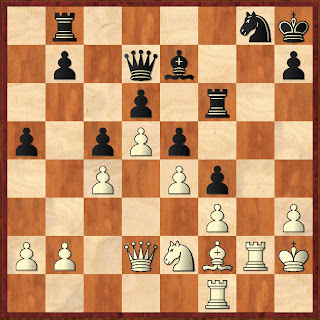
If that isn’t enough, in the following round ( 27), Taimanov attempts to take him down an obscure path of the Ruy Lopez with 3…Bb4. Geller’s opening knowledge and transpositional abilities plays it more like an Evan’s Gambit with tempo. This turns into a tactically sharp mêlée with Geller sacrificing two pieces to open up Black’s camp. The final position is shown here:


Bronstein’s opening comments on the game:


“ Why is it that today—as compared to ten years ago, let’s say—so few masters will go in for a fierce combinative attacks, with piece sacrifices? More than any other reason, it is because the art of combinative defense these days has reached such a high level that in the heat of the battle it occasionally becomes difficult to determine who is attacking whom.”


He places 6th with a score of 14 1/2 points.

Epilog:

His best candidates cycle was in 1962 at the Stockholm Interzonal where he finished second to Bobby Fischer. At the Candidates match he was only a ½ point short of playing for the title at Curacao, tying in second place with Paul Keres. He was known well for his openings expertise pioneering the development of the King’s Indian Defense, new variations in the Sicilian Defense and introducing the Geller Gambit in the Slav. He acted as Boris Spassky’s second for the World Championship match against Fischer in 1972, as well as acting as second for Anatoly Karpov and Tigran Petrosian.

He played strong in senior tournaments up into the 1990’s until the age of 70 where he tied for first place with Smyslov in 1991, and won clear first place in 1992.

As a side anecdote, One story he tells in his autobiography (Grandmaster Geller at the Chessboard, translated by B Cafferty 1969) is of playing in Belgrade for the Soviets against Yugoslavia. He complained that the Soviets didn't get any applause or credit for their games but in one game he was trying to find his matches in his pocket but couldn't. After a little while it became obvious to the audience what his problem was and out of the audience flew a box of matches, which he caught. That was the best applause he got.

He passed away in November of 1998 at the age of 73.

Sunday, July 05, 2009

Zurich 1953: Miguel Najdorf, Master of Opening Preparation


Born near Warsaw Poland on April 15, 1910 would have made him 43 at Zurich. He took lessons from Savielly Tartakower had some early success in Warsaw during the period of 1929-through the mid 1930’s where he won the Warsaw Championship in 1935. He Won a match against his teacher, Tartakower, in the same year. He played in several Chess Olympiads for Poland.

He moved to Argentina in 1939 to escape the holocaust like other players.The Nazi killed Najdorf's whole family, including his parents, wife and little daughter. His second daughter was born in Argentina. He started playing in the Olympiads for Team Argentina. In the 1940’s he started to play in some strong international events winning ahead of some players like Paul Keres and Stahlberg.

He was never considered a chess professional. Outside of chess, Najdorf achieved a similar success in an insurance business and was one of the richest Argentinians after WWII. He owned one of the most presentable sky-scrapers in Buenos Aires.

In 1947-1948 he was ranked as the second strongest chess player but still not invited to the 1948 World Championships following Alekhine’s death. FIDE decided that only those who participated in the 1939 AVRO tournament where the late Alekhine and Capablanca had played qualified for this match.

Let’s look at the his performance at Zurch 1953. In round four, he wins a brilliancy prize against Taimanov. Taimanov had a streak of success against the King’s Indian with a new variation against the mainline that had some circles saying the opening was finally refuted. A little history about this opening that evolved about the hypermodern movement of the 1920’s didn’t start to gain so much popularity until the 1940’s when Bronstein and Boleslavsky found success with making a queen side push with pawns, opening the c-file and targeting the base of Black’s pawn chain on d6. New variations had Black advancing the pawns on the kingside in a race to break things open. Taimanov found a maneuver of his queen’s bishop to favor the solid pawn chain and dance through the dark squared holes. Meanwhile, Najdorf having suffered recent losses with the same line, took upon himself to prepare a relentless pursuit of the king side to settle the argument of the KID being “solved”. He demonstrates great precision and a relentless attack sacrificing first, a pawn then offering a Bishop to keep the initiative and pressure on the White King.


Petrosian in round 6 offers a queen exchange in a materially even position that gives him structural problems. Najdorf picks up the point with a precision.

In round 10, he takes down Stahlberg with an “uncommon Store of positional capital” ( Bronstein quote). This book orthodox QGD has Stahlberg pushing e5 with out enough preparation. Stahlberg was hoping to gradually win through his tactical acumen after exchanging down and simplifying. Najdorf banks the accumulated positional gains and goes into the endgame with: a centralized King, a more active rook, strong bishop and an active knight. There was no hope for Stahlberg.

In round 12, he plays the white side of a main line Caro-Kann against Kotov. Bronstein comments that this was the only time Najdorf played 1.e4 in the tournament, AND the only time Kotov didn’t respond with Najdorf! Perhaps then, the inexperience shows as Kotov allows the Bishop to be captured on the g6 square AFTER he castles which I found a little odd. White focuses on a queen side pawn majority as the basis for his middle game tactics. Black was overly optimistic and tried to make a run with the kingside pawn majority but the structural damage didn’t bode well.

He had a few “GM draws” in this match. One good fight was in round 15 against Paul Keres. He had the black side of a closed Sicilian defense. Keres may have been avoiding the Najdorf variation by playing Ne2 which made for a quiet line with lots of symmetry. Long story short, Najdorf picks up an extra piece towards the end but ends in a draw because of White’s advanced pawn.

He finishes with 14.5 ( 19 draws and 5 wins) points and ties for 8th place with Geller.

Epilogue:

Another player who had played Che Guevera. In a wonderful book written by Najdorf's daughter she quotes Najdorf, that this game was not drawn. Najdorf told her that in this game he had offer Che a draw and that he had not accepted it. The game had gone on and Najdorf had won. In fact Najdorf said that Che had reminded him of the other game that they had played in Mar del Plata where Najdorf won. Guevara told him that he wanted to even the score. So according to Najdorf his score against Guevara was 2-0. She goes on to quote about her father’s relationship with Che. "My father was never a communist, but he always admired Che and the Cuban revolution".

Najdorf's lively personality made him a great favorite among chess fans, helped no doubt by his aptitude for witty sayings, taking after his mentor Tartakower. An example: commenting on his opponent at the 1970 USSR-vs-World match, he remarked,


"When [then-world-champion Boris] Spassky offers you a piece, you might as well resign then and there. But when Tal offers you a piece, you would do well to keep playing, because then he might offer you another, and then another, and then ... who knows?"


Najdorf remained active in chess right to the end of his life. At age 69, he tied for second place in a very strong field at Buenos Aires 1979, with 8/13, behind winner Bent Larsen (11/13), but ahead of former World Champions Tigran Petrosian and Boris Spassky. At Buenos Aires 1988, he made a very good 8.5/15 for fourth place at age 78. The next year in the 1989 Argentine Championship, with several other GMs in the field, he tied for 4th-6th places, with 10/17. His last national championship was in 1991 at age 81, where he finished with a minus score. Najdorf was an exceptional blitz (five-minute chess) player, keeping his strength into his 80s at the quick pace. He Died on July 4, 1997 at the age of 87.

Wednesday, June 17, 2009

Zurich 1953: Alexander Kotov, The tree of analysis

Alexander Kotov was born on August 12, 1913 in Tula, Russia. He was about 40 at the time of this candidates match in Zurich. He studied engineering in Moscow in 1939 but also studied a great deal of chess by then. In fact, in 1939, he almost beat Mikkhail Botvininik in the USSR Championship in the final round. The result qualified him for the title of Soviet Grandmaster, the third Soviet player to hold that very title after Botvinnik and Levenfish.

A couple more pre-Zurich matches that are noteworthy are his win as Mosco Champion of 1941; winning the Soviet title together with Bronstein in 1948; and winning in Venice in 1950 ahead of Smyslov. In 1951, he was granted the title of International Grandmaster at the age of 38! He won the interzonal in 1952 which was the pre-qualifier for the Candidates match.

A look at his games here in Zurich reveals a resourceful attacking player not afraid to mix things up a bit. In round 11 he plays White against Taimanov in a pseudo Reti/English opening. Kotov gets both of his bishops on the long diagonals while Taimanov tries for his usual Queen side grab. Missing an opportunity to free up his game and utilize a mobile pawn center, Taimanov instead locks his pieces up on the Queen side allowing Kotov to one by one migrate the entire team to an unstoppable attack on the King.

Round 10 shows a classic struggle in the Najdorf against Gligoric. White survives Kotov’s notoriously vicious Sicilian with a position that should play itself. But as Bronstein puts it, “The road to victory is a narrow path of precise moves”. Gligoric would haver faired better had he chosen the “natural” moves like Rooks on open files; then on to the 7th rank, pile up on the backward pawn, create a passed pawn then queen it. He decided to create tension in the center. Kotov, not being one to shy from a complicated game, takes the initiative, then the open files, then the occupation of the 2nd rank…and follows through with the very things White should have done. It’s a nice turn about.

Round 14 wins Kotov a Brilliancy prize against Averbakh. This is one of those games that is almost as famous as a century ago with Anderssen vs Kieseritzky. It involves a queen sacrifice of the intuitive nature. One that goes beyond, Kotov’s tree of analysis stuff. On Move 30 the following position is reached with Kotov ( Black) to move:


Bronstein comments:


The creative element in chess is generally thought to consist of three things: logic, accurate calculation and technique. There is a fourth ingredient also, however, perhaps the most intriguing of all, although it is often overlooked. I refer to intuition-chess fantasy, if you prefer.
Occasionally a position arises in the course of a game which cannot be evaluated on general principles ( pawn weakness, open files, better development), since the state of equilibrium has been upset on several counts, rendering an exact weighing of the elements impossible. Attempting to calculate the variations doesn't always work, either. ( he goes on to say:) ... It is fantasy or intuition that comes to the rescue, that has given art to chess its most beautiful combinations, and allow chess players the joy of creating....Intuitive games were not only played in the days of Morphy, Anderssen and Chigoran.
30… Qxh3! Comes out of the blue. The whole point of the sacrifice is to draw the King out to f5 where it is exposed to the two rooks, knight and Bishop while White’s other pieces sit hopeless. It’s rather beautiful.

In the next round, he beats Szabo
in a game of opposite wings castling. But, being Kotov, this is not your typical pawn storm versus pawn storm on opposite wings. Rather, both sides end up pushing pawns in front of their own kings? Why? A game with a closed center tends to have peculiarities as such. Black castled short and attempted a break on the g-file and advanced the pawns. Meanwhile, White, castling long, gets a break on the b-file and fills it with major pieces. Both sides had breakthroughs but White had the initiative.
In round 23, he beats Reshevsky when he should have lost. The game looked rather drawn for the first 28 moves with lots of maneuvers but no real targets. Boredom coupled with the desire to mix things up, makes Kotov take a risk with a pawn move that weakens a couple key diagonals ( moves the f2-f4 and now c5-g1 and a8-h1 are weak). Reshevsky over-estimates the possibilities and returns the favor to give Kotov a chance to equalize and wiggle out of complications. Like a cat, he survives the middle game and enters a knight and pawn ending with a stronger knight position. Reshevsky attempts to sacrifice his weaker knight to gain two passers but they get stopped as Kotov had his own baby queen en route.
Smyslov, as you may know, is the key player in this match ( not to spoil the series…but since the book has been around for almost 40 years… Smyslov wins). He’s almost undefeated until…. Round 21 against Kotov. Kotov plays 1.c4 and brings on a space grabbing closed position. Black recovers from the opening by liquidating the center and then advancing and fixing a pawn on White’s e4. At one point, it appears Black gets over confident and lands a knight in a way the allows Kotov to sacrifice a rook for two minor pieces. The endgame shows how the “extra material” can be of advantage. Huzzah!
In a loose translation from Kotov’s “Memoirs of a Chess Player” :

At that point, Smyslov was leading. I was somewhere in the middle of the tournament table. Reshevsky was right behind Smyslov. The reader will understand my situation: just as in Groningen, I had obstructed a colleague’s path to the supreme sporting title, without the win bringing any material improvement to my own tournament position. I understood very well the absurdity of what had happened, and that I would not get any plaudits for this win over Smyslov from my compatriots, who so closely shared in the successes of the Muscovite.

It is sufficient to say that when, as usual, I telephoned my wife in Moscow that evening, she immediately asked me:

“What are you playing at over there? I’ve had chess fans on the phone here, cursing you. Is that what you want?”

But there was nothing to be done – sport is sport! I secretly hoped that I would be able to undo some of the damage later on. I still had one more game to play against Smyslov’s main rival, Reshevsky. And so it happened. Exploiting Reshevsky’s inaccuracies, I won.

Epilog:
Alexander Kotov’s Legacy is in his writings. I think one of the most popular books is “ Think like a Grandmaster” where he talks about the tree of analysis and other ways to prune the candidate moves. What’s even more remarkable is that until that book was published, we had “handbooks” on positional play, tomes on endgames and openings, puzzle books but none really on thought processes. He had a whole series on the “Grandmaster” theme. He was a very prolific author. He died in Moscow on January 8, 1981.

Wednesday, June 10, 2009

Zurich 1953: Mark Taimanov, the Romantic!

Much is already available about the biography of this well rounded chess player. On chessbase.com you can find an autobiography written in 2006 when he turned 80. http://www.chessbase.com/newsdetail.asp?newsid=2927

Being born on February 7, 1926 made him 27 at the time of Zurich. He was a freshly minted GM ( in 1952) and it sure showed. Though he tied for 8th place in this candidates match, his style shows a strong positional player who knows how to build on accumulations of small advantages meet hyper-modern games with some ingenuity .

Let’s start with looking at how he defeats Petrosian in round 5 with the Black pieces. Taimanov launches into a Queen’s Indian defense and Petrosian starts out by provoking the move c7-c6 to block that queen-side fianchettoed bishop. The game bounces in a typical White attack on the queen side versus black trying to stir up a central attack. Not willing to get strangled, Taimanov opens up the center by taking a risky knight move to e4. He follows through with the exchange and parries a double threat by exchanging his rook and 2 pawns for two knights.

(see diagram after move 17 ...Rxe4) This creates the right psychological imbalance as he secures White’s central pawns. Despite his exposed King hiding behind his pieces, Taimanov prevents Petrosian from rallying his rooks and exchanges one pair off the board while creating his own mating threats. In the end, the bishop pair trumps the white pieces.

He takes Averbakh, the end game technician if you recall, to task in round 6 through the exploitation of more than one weakness. The Game takes on a sort of Nimzo-Queen’s Indian flavor. Taimanov, as White, provokes the bishop exchange for knight on c3 as an incremental advantage to gain control of long term dark squares and a Bishop pair. Averbakh underestimates the weakening of the dark squares and the importance of a knight on f6 or f8 as he tries to create structural unsoundness in the center for white. The middle game struggle continues with Taimanov keeping his game flexible with a central knight posted. He fakes with a pseudo minority attack on the Queen’s side which gets Averbakh moving his forces in the wrong direction. Then he drives home with a bold mate threat. The threat itself is not the advantage but its how Black has to respond that leaves him in a positional zugzwang. In short, the long diagonal ( a1-h8) becomes too much to defend as this Romantic plays a late game King’s gambit ala Taimanov to open up a the diagonal black desperately tries to close.

In round 9, Stahlberg is taught a less on three weaknesses. Placing pawns on the same color as the remaining bishop is very sad. Getting rid of the king’s fianchettoed bishop makes for a weakness on g2. Finally, seizing the 7th rank is overwhelming when you have your pieces immobilized.

The interesting thing in round 12 against Geller, is that the wedge pawn formation of white’s c4-d5-e4 versus black’s c5-d6-e5 is actually more advantageous for white. Taimanov demonstrates the increased mobility having three ranks to maneuver versus two as he clears the third rank of pawns and swings his queen from one side of the board to the other like Tarzan and doubles rooks on an open b-file.

Taimanov faces Petrosian’s grudge match in round 20. Petrosian fights with the black side of a Nimzo-Indian and Taimanov takes him down an old and odd line of the Rubestein variation that almost looks like a Hubner. Taimanov also knew that in several earlier games of this match, it was important to take control of the center and get e3-e4 in. Otherwise the results seemed drawish at best in this attacking line for Black. He realizes that attacking the Queen’s knight allows him to play f2- f3 and e3 –e4. He then goes after controlling the dark squares which psychologically puts Petrosian on the defense early on in the game. At the last stage of the game,

he sacs a rook ( giving back material actually) to create an unstoppable mate threat.

But, wait, there’s more! A long game with Stahlberg again in round 24 shows in 72 moves the finesse of a knight ending. But the last one I want to relate is his victory over ( think like a grandmaster) Kotov in round 26. As white in a Nimzo-Indian variant with a d5 thrown in. He shoves that d5 down Stahlberg’s throat and opens up the c-file, creates structural pawn problems for black and storms the back rank.

Epilog

Mark Taimanov beat 6 world champions in his dynamic career defeating Botvinik, Smyslov, Tal, Petrosian, Spassky, and Karpov. It’s with regret to know because of his defeat by Fisher 6-0 in 1971, the USSR stopped his salary and prevented his ability to travel overseas. The man beat 6 other World champions!

It comes as no surprise that he has a a few opening variations named after him in the Sicilian, Benoni and, of course, the Nimzo-Indian.

Now, about the romantic, with his first wife, Lyobov Bruk, he formed a piano duo. He made some recordings that were included in the Great Pianists of the 20th Century ( Philips and Steinway series). You can learn more from the link provided above to his chessbase.com article. He goes on to mention about being a child actor of all things.

He doesn’t mention his brief marriage to Averbakh’s daughter in the 1970’s mentioned in my last post. After that marriage dissolves ( little reference on that and I am not 100% sure the accuracy of this), He marries a young Nadya and fathers twins in his retirement!

He is still playing some sweet music to this day on 88 keys and 64 squares.


As for my lead-in photo, I could not resist the shot with Che Guevara. In Taimanov’s words:
This is one of my most cherished photos. In it, following my game at the Capablanca memorial in Havana in 1964, is one of its organizers and spiritual leaders, one of the most legendary figures in the history of Latin America and of the revolutionary movements – Che Guevara. We were on very good terms, met at this and at other tournaments and even played chess in the Soviet embassy building. This was the brightest, romantic person, an idealist who thought that his place was in the barricades and not in the offices. This photo is also dear to me because it is signed: "To my friend Mark Taimanov. Che."

Sunday, May 31, 2009

Zurich 1953: Yuri Averbakh, Endgame machine

Born February 8, 1922 in Kaluga, Russia, Yuri Averbakh got noticed in the chess scene when he won first place at the 1949 Moscow Championship. He became a grandmaster in 1952. I couldn’t find much more about his earlier chess life. He would have been 31 at Zurich. Becoming a grandmaster at age 30 was fairly common back in this period.

Looking over his games at Zurich 1953, it’s surprising he finished in 10th place ( tied with Boleslavsky) but this may be a result of the 17 draws, a lot of them being rather quick. His playing style was rather solid and may have contributed to the numerous draws because in his own words in commenting about his plus score against Nezhmetdinov :


“If Nezhmetdinov had the attack he could kill anybody, including Tal. But my score against him was something like 8½–½ because I did not give him any possibility for an active game. In such cases he would immediately start to spoil his position because he was looking for complications."


“No possibility for an active game” in this match meant a lot of drawn games with quite a few early draws. This solid style would flourish if his opponent would attempt to find complications. He’d transition the opening to a middlegame that targeted a favorable endgame where he was like a machine.

Paul Keres in round 2 fell prey to this advanced thinking style of play. It starts out as a Nimzo –Indian but Averbakh uses a slight move variation on move 9 that gears him up more for a solid endgame rather then dynamic middle game. White tries to break open the center and it costs him a pawn. That’s all it takes for Averbakh as he reduces the forces to a quick endgame of rooks and minor pieces with an imbalanced pawn network.

He beats Euwe twice. The first time in round 11 on the Black side of a Nimzo Indian. Here, the formula had Averbakh gaining some space on the queen side where he advanced the pawns as far as he could blocking in Euwe’s dark squared bishop before transitioning to an endgame. Euwe tries to counter with an attack on the king side but only gets forced into a series of major piece exchanges. With the more active pieces, Averbakh maneuvers the knights over to where he banked his pawns on the queen’s side, sacrifices a knight and facing 3 advanced passed pawns against a weak bishop, Euwe resigns.
He meets Euwe again in a later round ( 26) and plays the white side of the Nimzo-Indian. The struggle in the middle game is white’s potential of advancing e3-e4. Euwe managed to block in Averbakh’s dark squared bishop ( as payback for round 11). At a crucial point in the game, Euwe exchanges down but that actually leaves Averbakh with an endgame edge with better placed rooks and king position.

Round 21, against Taimanov shows us a different style of play from Averbakh. He shifts gear and goes after an uncastled king aggressively in this open Sicilian. He starts with a counter-attack on the queen’s wing and transposes it to a central attack with a surprising e4-e5 pawn gambit. It opens the position as he sacrifices a bishop only to get the material back with interest a few moves later.
His last win is the next round with Najdorf in a classic struggle with Averbakh’s style of play. By move 12-15, he has already got the position he wants for a favorable endgame with his knight versus Najdorf’s bishop. He fixes the white pawns on the color of White’s bishop all the while creating a great outpost. The queens are exchanged by move 16 and on move 21, Bronstein comments: “ White’s position is unbelievable” and remarks about the weak pawns, the passively placed bishop and the “gaping hole” for the black knight on c4.

Five wins, 17 draws scores him 13 ½ points placing him even with Boleslavsky.

Epilog,

In the following year, he wins the USSR Chess Championship ahead of Korchnoi and Petrosian to name only a couple. In 1956, he ties for first in the same Championship wuth Spasky and Taimanov but lost in the play-offs. He did qualify for the 1958 Interzonals at Portoroz but ended up in a tie for 7th place, half a point short of placing him in the candidates match.

It’s no surprise that Averbakh published over a 100 endgame studies, many of which have given notable contributions to endgame theory. In 1956 he was given the title of International Judge of Chess Compositions and in 1969 became an International Arbiter for FIDE. He edited a couple of soviet chess journals and a four volume anthology of endgames. He also published science and science fiction stories for the Soviet publication ‘Znanie-sila’ ( Knowledge is power).


His daughter Jane, marries Taimanov (after his divorce from Lyubov in the early ‘70s and before he later marries Nadya… but more on this stud later). He's still alive today at age 87.