Friday, June 12, 2020

Building a training database


From my last post,  an intro to chess databases, a couple folks were eager to learn how I set up my training database.  I thought I’d share the steps I took and a little on how I use it.  A couple questions I asked my self when setting this up were:


  1. How well do I know my repertoire in as either Black or White?
  2. Which lines am I actually encountering in these openings I chose to play?


The second question is really important as training for ALL possible outcomes is like trying to boil the ocean. I suggest using the database to help whittle this down as the outliers will come but the intent will be to handle 80-90% of what you face and you can bolster your training with the sidelines as they come in post mortem analysis.


Finding the common lines played within your own games

Maybe in another post I will walk through some steps on how to build a repertoire data base. Chessbase has some tutorials. There are videos out there too. Last time I showed a simple step using the database’s statistical tools and coming up with a pareto chart of common openings based on the ECO labels. It provides a quick snap shot.  You can even filter your data base to games you played only with the Black or the White pieces.   Here’s that chart again for reference.  Note, B12 is a common line in my games with the black pieces.


You could also use the reporting functions in chessbase and Generate a Repertoire database of your own.  I’ll do a couple of short cuts here as I really want to spend this post on the training side.


  I generated a repertoire in both Black and White using this function in my games database and here’s a look at the Black repertoire:


Big surprise, B12 (Advanced Caro-Kann) is my common theme here.  How you get to the common lines played is up to you. Whether you use the statistical functions of the database or report generation, both are useful insights that can save you some time for preparing a more focused training database.


Finding Annotated games for the training database

If you made it this far, you now may  have an idea what lines are played most in your games and you are ready to start your collection.  The MegaBase … the 8million strong…. has some annotated games in it. You can filter the Megabase to only have annotated games and create a separate reference database of this collection as well.  I looked in this collection for ECO  B12 games and found a few but buyer beware. Some are in another language while some are “a couple of additional lines from someone’s chess engine analysis”. There are some “verbose” ones but it’s hard to understand if the audience is meant to impress the masters or appeal to us mortals.


I wanted something that appealed more to the simpleton that I am.


I’m a lazy man with moderate means

The everyman series of books have been my go-to resource for “patzer needs to learn an opening” because they are verbose and written not to impress higher rated friends but rather written so a drooling imbecile, such as myself,  can understand it.  If only there was a way to import these books into a chessbase.

Years ago, I got really into Mike Leahy’s Bookup database software (now called Chess Opening Wizard) where I would search pgn files for my repertoire and meticulously import them. I would manually pick my lines and enter the text from the books laboriously. That was a lot of work, I was …younger… but I needed a better system.

I found out that Everyman Chess has ebooks! Which means, not only can you get the book for an ebook reader, but for the cost of the book, you can get not only the PGN version, but the CBV version for chessbase too!  YAY! Take my money as I am done transcribing books into a training database.  For instance, here a couple books I picked up for the cost of a chess book.


The move by move series is wonderful. It sets up questions like “Why move the knight to d7 instead of c6?”  This is the level of stupidity I need and seek for building training.  Going back to the advanced Caro-Kann theme in my black repertoire, finding games from the ebook collection was relatively easy:


I could select these and copy/paste into the Black side training games.  When I do this, I am careful to edit the game data so I can read it like a training database and easily select the game to train on.  

In the example shown, I append the last name of the white player to Black player’s last name so it shows up as a hyphenated so-and-so vs what’s-his-face.  In the White last name field, I enter a label. Here I used C-K advanced 3…Bf5 4.Nc3.  Use a system that works for you.

Looking at my Black side training Games, I have a nice list I can see immediately and select where I might want to train.


From this list, I extracted and relabeled all my games from the various Everyman ebooks I (recently) picked up and I am very satisfied with the results.  Keeping this to  manageable short list of training games ( 30-50) means I can use this iteratively and go a little deeper each time.


Using the training sets, I can click on a selected game and use the Replay Training function in the game view and select which side I wish to train on.

So here’s the thing, because I play amateurs such as myself, knowing the line  to the 15th move order or more is a waste of time.  I might get to a known tabiya in about 30% of the games, but mostly it’s about understanding the first few moves enough so that I can avoid the crappy traps and the “anti-whatevers”  that other amateurs, thinking they are tricky, will throw my way. When you play at my level, it’s the wild wild west and anything goes. I like playing stronger players for the very reason I can get to a known tabiya but lose mostly to middle game stuff.  Rather, training into these lines no more than 10 moves deep and really understanding the verbose explanations within those first few moves is a good remedy to avoiding sucker punches.

After my games, I use this as a reference to see where I may have drifted off or my opponent played off the main variation. If the variation didn’t exist in my training, I will search back in the ebook first for any missed lines.  If that doesn’t exist, I will go back to my game and use the MegaBook I created and see if it’s in the book and what is the proper response.  I tend to make use of the Master reference database, Lower rated Amateur database and a Live Base offered by chessbase.

Well, I hope you found this useful or at least got a couple ideas of how to prepare better for your games. I will say, since most of the chess world has moved to online play, and that means mostly rapid games, my Blitz rating jumped 300 points since I started using this tool. Even though I am slow curmudgeon, I am learning to adapt to a quicker world.


Until next time,

-Blunderprone


Saturday, June 06, 2020

Why have a chess database?


If you’re like me, a chess player of an older demographic with a bookcase of full of chess books and rating that’s as stuck as a rusty bolt on old lawnmower in need of repair, hearing about using a chess database is probably the last on thing on your mind. I am a willing old dog looking for new ticks and have renewed my interest in updating and using a database to help catalog my games and maybe learn something new.

Sam Copeland did a great job outlining the variety of online and offline databases on this post. I recommend spending a little time looking through it.


What was I looking for in a database?

Over the years, I’ve used a variety of revisions of the software tools from chess base. I wanted familiarity with horsepower. I was willing to spend the extra bucks so I didn’t have to build something from scratch and import PGN’s and game collections. Though, I like the DIY spirit of open software and free imports to stick it to the big guys, I’ll save my revolutions for other social injustices.  

  •        Large database to reference
  •        Ability to import my games
  •        Annotating my games
  •        Setting up training positions from my games
  •        Gain insights for next steps on where I need to train
  •         Develop and grow an opening repertoire from my collection
  •         Ability to access the database on both table top and portable devices connected

I went with a package from ChessBase and got the database manager along with the megabase of 8 million games for a reference base. I can set up the database files all on a shared OneDrive to use between devices. I got busy.  Here’s a snap shot of some of the items on my cluttered “top shelf”.


Holy Crap, what Am I going to do with that 8 Million game data base?


Yes, the Mega Data base is huge. Working with such a HUGE file as a reference while refining opening preparations can add to your frustrations as the system will lock and constantly refresh.  I suggest creating smaller reference data bases using the filtering function. 

Searching for games where BOTH players are rated ELO 2500 or higher pares down the beast to a solid list of MASTERS ONLY games. I created a reference database from just those.  Refining the search little bit more to Master only games with recent games ( I went back 10 years) made a good reference for OPENING BOOK from this collection.    

The other thing I did was create a reference data base of LOWER RATED Games. Why would I do that? I’m an amateur and I play other amateurs. If I am looking at opening moves most likely played, looking at a data base of LOWER RATED players gives me offshoots most likely played so I can prepare for this. If it’s a move I am looking to make, I’ll hop back to the MASTER GAME REFERENCE or look at the MEGA OPENINGS BOOK.


Using the cloud

There’s a working directing called “My Database” and then there’s a shadow directory under OneDrive > Documents>ChessBase that you can set up called “My Work” and I use this to share between devices.


Here, I create backups to various ‘bases” I’ve created. I like the flexibility of going portable for my devices or having the workhorse on my main system to run a batch of game analysis on recent games I imported from my online activity.


Gaining insights from my games

In the above image, you may have noticed the heart logo named “2020games”. This is a collection of my games I either imported from chess.com, lichess or meticulously entered move by move from over the board games since the beginning of the  year.  One of the things I can do with this when I click on it is to look at statistics on my openings. 


I can use this information to better prepare for my most common encounters.


A topic for another time maybe is how one can create a repertoire database from this and even the training databases you may have seen in the images above with the sneaker Icon. Basically, from the statistical insights from my games, I prepared a training database for my white pieces and black pieces based on the most common responses from the activity.


This is a snap shot of how an old dog is learning new tricks to loosen a rusty bolt in hopes to turn that motor over some day.


Until next time,


-Blunderprone


Friday, May 22, 2020

Practicing Imbalances Part 3 : Seeking in Critical Positions


In this post I’ll finish this series around the book, How to Reassess Your chess with a brief summary on static and dynamic imbalances. But mainly, I’ll also walk you through a recent game (loss) with National Master and how, for me, it’s a learning curve in applying these. Yes, of course I lost…but not too miserably. I believe my practice is making me better at picking candidate moves as I made I all the way to the endgame with the master and a great lesson was provided.   


The rest of the story:

  • (Superior Minor Pieces …discussed last post)
  • Pawn Structure (Many have written about this)
  • Space (Annexation of territory on chess board)
  • Material (Silman used this to justify exchange sacrifices versus owning pieces of greater value)
  • Control of a key file or square (files, diagonals … you get the drift.
  • Lead In Development (Dynamic …fleeting … temporarily giving you more force in a region of the board)
  • Initiative (Again Dynamic, fleeting and temporary dictating the tempo of the game.)


Silman had a lot of Nimzo-Indian games in the section under pawn structures making the argument for when double pawns can become assets. I decided to shift my repertoire to using the NID because I felt it was easier to understand plus I used to play it regularly 325 years ago before switching to a Slav.

He puts a lot of rules out there for each of the imbalances that for some become common sense but for dense forests like myself I still have to think through the thickets. I believe that eventually, practicing the puzzles beyond the book and in my games I will eventually develop a better common chess sense.

 A walk through a recent game.

Rather than regurgitate Mr. Silman’s words even more than what I’ve done, I thought I’d spin the board around and show you a recent game I played.  Keep in mind, over the board tournaments and club activity during the time of COVID-19 has driven everything online.  Finding a trusting group to play longer time controls than Blitz or Bullet lead me to a weekly G60 + 10s incr swiss with a local club.


My First round had me playing white against a National Master.  I knew he played the NID and I wanted to walk through the Hubner variation as I like the pawn structure coming out of the opening and familiar with the double c-pawn. 

1.d4 Nf6 2. c4 e6 3. Nc3 Bb4 4. e3 O-O 5. Bd3 c5 6. Nf3 Nc6 7. O-O Bxc3 8. bxc3 d6 9. e4 e5 10. d5 Ne7 11. Nh4 h6 12. f4


I just played f4.  I looked at the locked advanced pawn center and decide to play the 11. Nh4 with intent to advance the f-pawn because I felt I needed to open the position up a little more for my Bishops. I did not “know” this book line and the NM pointed out it was a line from the famous Fischer-Spassky match.  The favorable imbalance I had was the 2 Bishops… my thinking… open the position. Where to play? Kingside since my pieces are “pointing” there.


The game continues:

12…exf4 13. Rxf4


Tim pointed out that the 12…exf4 was not accurate and in the Fischer-Spassky Ng6 was preferred. But I “returned the favor” by capturing with my rook.  Ok, I did see the g5 fork and I felt better with my rook there as I can capture the f6 night and it’s a material exchange. I didn’t see after 13. Bxf4 g5 14. Bd2 gxh4 15 Rxf6 can still take place.  That’s why 11…Ng6 is so strong.


13…Ng6 14. Nxg6 fxg6 15. h3 Qe7


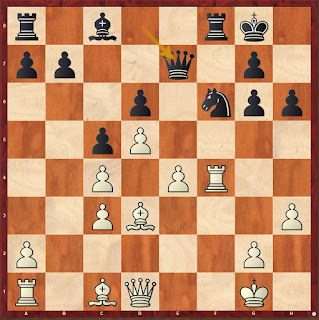
This was a critical position. My favorable imbalance with the bishop pair remains. I was looking at Black’s weakness on d6 and was looking for a strategy to optimize this.  My Rook on f4 is now sticks out like a sore thumb and my dark square bishop is jealous. But rather than calmly think through the process I feel into a “Kotov Syndrome” played 16 Qe1 thinking “dark squares” and e4… maybe I can gain something.


Suggested by my opponent was 16. Rb1 with an intent of putting some pressure on the q-side pawn majority (long term insurance for Black’s game in the endgame). This at least would bring my least played piece into the game, minor lift to b2 then over to the kingside for the party… all would have been a better plan in theme of the position.  I also think that regrouping with 16. Rf1 and if Nxe4 I have 17 Re1.


The rest of the game… I panicked and went for a series of exchanges. All opposite of what Silman’s teachings would have said.  If you are planning a King side attack, keeping the queens on the board is important. If you have space, DON’T exchange.  But no… I figured, crap! … if I disarm my opponent maybe I can get to a playable endgame

16. Qe1 Bd7 17. Rf3 g5 18. Bd2 g4 19. hxg4 Nxg4 20. Rxf8+ Rxf8 21. Qg3 Ne5 22. Rf1 Rf6 23. Rxf6 Qxf6 24. Be2 Ba4 25. Bf4 Bc2 26. Bxe5 Qxe5 27. Qxe5 dxe5


We just took the queens off the board. My opponent’s comments after the game “ every exchange was in my favor”.


Did I have a slim chance to pull off a draw or turn that passed d-pawn into something more?  In the position above I had a choice of saving the c4 pawn or the e4 pawn. In the grand scheme of imbalances, I chose the wrong pawn and this game the NM two opportunities to create outside passers.


To add insult to injury, I exchanged the bishop too!  Had I played 28. Kf2 first then after 28…Bxe4 29. Bf3 if he exchanges… My king on f3 I think I would have better managed the king side pawn majority as the pawns on the queen side could hold the line over there.

28. Bf3 Bd3 29. Kf2 Bxc4 30. a3 Kf7 31. Be2 Bxe2 32. Kxe2 b5 33. c4 a6 34. Kd3 h5 35. Kc3 g5 36. Kd3 h4 37. cxb5 axb5 38. a4 bxa4 39. Kc4 g4 0-1


Here’s the complete game if you want to click through it.


Maybe easier to view at Chess.com

https://www.chess.com/a/379ipg6ut2HDGN


Summary


This was my first longer than a blitz game with a real opponent in months and after the Kotov/Silman deliberate training.  I still have work to do on visualization and calculations (note the 13.Rxf4 and not taking a safer approach with Bxf4) especially where I see a one mov threat ( pawn fork). My minds eye and inner panic meter seems to create blind spots that I can now focus on.


The other part is finding the best move in a critical position on the board. I guess here, defining the critical position where the position is somewhat balanced but with equal favorable imbalances on both sides. 


Move 16 in the game was one of those positions.  I may have spent about 10 minutes trying to figure out what the position demanded.  I wanted to open up the center just enough to BOTH bishops active.  I didn’t do a “fantasy” position as suggested by both Silman and Kotov.  Had I done that, I would have found either the 16 Rf1-e1 with Bf4 central strategy or the Rb1- b2 – f2 strategy to get my least placed piece into play.     


That ends this series on my studies of Positional imbalances. I’ll continue to practice and report any progress or regressions because … it’s all ebb and flow in the learning with a leaky bucket.


I may shift gears in the next post. I’ve been doing some work in faster games out of necessity and also how I am using databases to help my training.

Thanks for putting up with my amateur insights/ oversights.

Until next time,


-BP


Wednesday, May 13, 2020

Reassessing Imbalances Part 2: Silman’s thinking method and Thoughts on Superior Minor Pieces

Today’s post will continue the discussion on insights I gained ( or reinforced those suffering brain cells) from taking a deliberate training approach to going through his How to Reassess Your Chess book. I paid more attention to the process he outlines and deliberately focused on improving my ability in these three areas:
  • Recognize the imbalance(s)
  • Assess it’s importance over others ( Very nuanced)
  • Properly looking to the position to guide my candidate move selection (Chasing unicorns)


Silman’s Thinking technique:

Silman’s writing style is a little condescending at times. I’ve learned to take it with a grain of salt and just become as receptive as I can to his ideas without feeling like I’m back in third grade with the teacher assuming I am going to do nothing but cause trouble. Okay, so maybe I was a troublemaker, but if the material was interesting enough, I would listen. Wrist rockets and hallowed out books with radios embedded inside all set aside, I approach professor Silman with an open mind. The thing I caught this time that I didn’t during my speed reading passive absorption approach was his interesting thinking technique.  Having spent some time with the toady, Kotov and his TLAG… I was open for a new approach.

Silman lists a 5 step approach:
  1. Figure out the Positive and Negative imbalances for both Sides  ( a tall order but this book puts it all out there)
  2. Figure out the side of the board you wish to play on ( Hint: it’s not really where YOU wish but understanding rather where the POSITION thinks you should play)
  3. Don’t calculate! Instead fantasize!  ( Where would you rather have your pieces… be reasonable)
  4. Once you have a fantasy position… can it be achieved reasonably well?  If not, iterate on the previous step until you have a position that can be reached.
  5. Once you have the position in mind…only now do you actually start looking at moves to get you there ( Candidate moves) and begin calculating.


The entire book is about establishing a firm footing in the first step but even at that, deliberate practice will help improve your ability to be able to assess the position from a perspective of imbalances.  I’m still a ways off, but I have noticed a little improvement when I am testing myself with exercises in the book or an annotated game. I am more likely to evaluate a position to at least 80% accuracy in terms of all the imbalances

Figuring out which side of the board is tricky without solid footing in these ideas especially in relatively neutral positions where both sides have trade-offs.  Looking at queen-side versus King side versus central plans can get tricky when faced with multiple imbalances in a position. Which one weighs more than the other? No clear answer and a lot like what Kotov would say, “it depends”.  The rule of thumb, “When in doubt go for a central plan.” Is good enough advice for this amateur to follow, especially in online blitz games.

The fantasy piece placement in this section seemed to rely heavily on how to place minor pieces more than anything else. In particular, looking for good outposts for knights was common.  But if you wanted to get a rook on an open file or open a diagonal to activate a bishop, then the fantasy may be around exchanging pieces and pawns to get that job done.

Superior Minor Pieces:

In the chapter on Superior minor pieces, he goes into great detail on position 63 from Alekhine-Junge Warsaw 1942 with white to move. He walks through the process, scolding us “3rd grade amateurs” on imperfect evaluations and how the correct and ONLY way to proceed becomes obvious if you follow his steps. But I get the point. Having a process to follow will help develop clarity in the position.

The chapter gives a great overview of good versus bad bishops and how to mitigate either depending on which side of the board you are on.  The epic Bishop versus knight battles and many other nuances are covered between what makes one minor piece more superior than the other.  What stood out for me was the valuation of knights depending on what rank they sat on compared to a Bishop.

  • Knights on 1st or 2nd ranks are mostly defensive or transitional
  • Knights on 3rd are mostly defensive but ready to jump to a more aggressive  5th rank position
  • Knights on the 4th are as good as a Bishop. Positioned as both defensive and attacking
  • Knights on the 5th are usually better than the bishop.
  • Knights on a 6th rank often have a winning advantage.


I knew about getting knights to outposts (usually on 5th rank) can be a strong point in the game but this has to coincide with your other pieces and plans of attacking.  I’ve also been on the receiving end of a knight plunking right down on my third rank (his 6th) and wreaking nothing but havoc.  In evaluating minor pieces in a position that is unclear, knowing these valuations of knight placements is a good tool in ascertaining the level of prioritization and importance of said imbalance over others in the position.   

Next time:

I’m hoping to wrap up the series in Part three with light discussions and insights on the other imbalances from this amateur’s perspective.  Thanks for putting with me.  Until next time.


-          Blunderprone

Wednesday, May 06, 2020

A Game of Imbalances: Part 1


When I was first starting out in chess, the book to own was “My System” by Aaron Nimzowitsch if you wanted to understand the finer points of positional play.  He had words like “prophylaxis” and  more words to describe variations of pawn chains like an Inuit  has for snow. This is because his treatise is about the school of hyper-modernism where pawn centers are formed and piece activity is around attacking the center positionally. Quite dated and his concepts mostly holds with some exceptions today. I consider it a historic piece much like Staunton’s or Tarrasch’s  guides on positional play were over a century ago. I’ve read this book long ago, and yes, I could use a refresher. BUT this post will not be about Nimzowitsch’s insights, rather about how Jeremy Silman came and had us re-assessing our chess with the concepts of a more dynamic approach to looking at today’s games from a sense of positional imbalances.

Lesson’s from this amateur seeking improvement:

Don’t do what I did when I first got this book. I read it as quickly as I could passively absorbing the 7 imbalances, rifling through the exercises, not really giving them much thought and going directly to the Solutions section to “reassure” my ego that I knew what he was talking about.  To add insult to injury, I purchased the “workbook” only to try a few of the problems, fail an head directly to passively absorbing the lessons by nodding in approval of the solutions as if “I would have guessed that.”  Take my money please. No… not recommended. Not if you want to really learn and absorb the information. Slow down, genius.

This post will serve as my re-introduction to the new study I did using my slower approach and introduce the imbalances he brings up.  In parts 2 and 3 (I may do this in 4 parts… unsure yet) I will split up what I discovered from an amateur’s perspective on the imbalances.

My approach and fixing a leaky memory bucket:

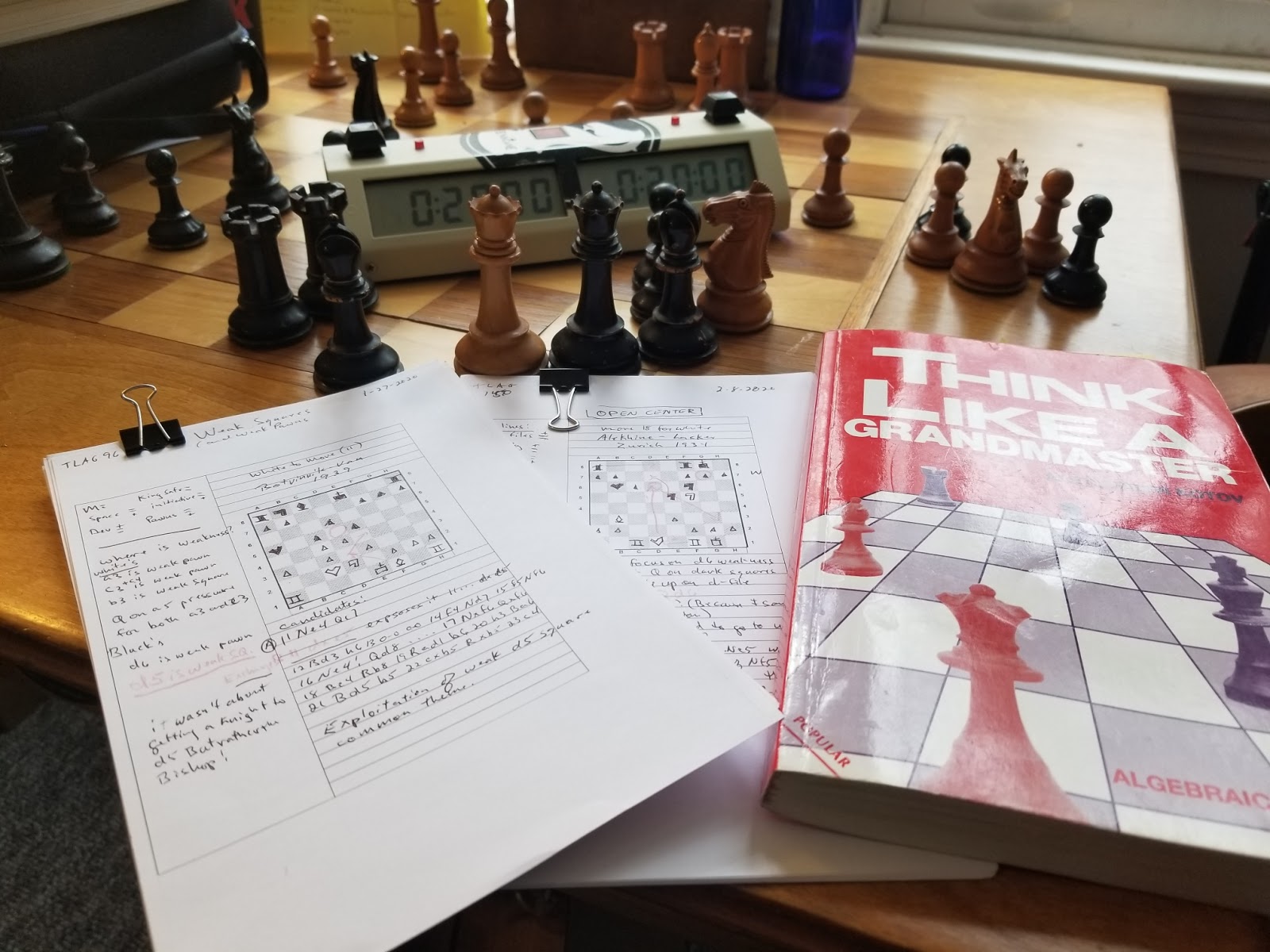
I posted previously about slowing down and “going old school” as some commenters have mentioned.  There are over 200 diagrammed positions in How to reassess your Chess. I set each and every single one of them up on a chess board.  I used the clock on the end of chapter exercises set to 20 minutes and used the notation mentioned in that older post. Only after the clock ran down and I was through my own evaluation and analysis did I check the solutions section.  Just like I did in my recent studies with Kotov’s TLAG here and here, I created a set of notes using a method I adopted from Cornell University.

This approach falls under  deliberate practice . Rather than rote memorization (I don’t have a Eidetic memory as I posted a few years back) or my lazy  passive absorption techniques, I do find that when I am more engaged in the learning process the better I can retain. Let’s just say, at my advanced age and many years in my misspent youth doing youthful indulgences… my short-term memory plain old sucks. Three is my magic number I can juggle before having a good recall mechanism in my long-term storage which surprisingly survived the rock concerts and extra-curricular activities associated with such. The act of setting up the board, physically moving the pieces.. on a really comfortable and nostalgic set from my youth ( thanks to dear old departed dad)… seem to all help with my learning and retention process.  I’m a visual and tactile learner. I learn best through examples and doing it on my own with the right guidance. 

What I learned from the Kotov experiment is that I can retain more of the information from TLAG  and start to synthesize the material …especially around visual analysis. I knew the roadblock I faced (still) around picking the cadidates but I am getting better and it lead me down the path to “Maybe I can learn from Silman now”.  And I am.

What were my goals?

When reinvigorated my approach to studying back n January it was to improve my over-the-board (OTB) experience in slow tournament games. I wanted to improve my visualization for analysis in 3D like OTB and improve my positional sense so I could find …that seemingly elusive unicorn called candidate moves that seems to come natural to others.  Thank you to all who have commented so far offering advice… and am eventually getting there as well. But first I had to learn what I did not know.. if that makes sense.  Like learning an musical instrument on your own and by ear or listening and mimicking other musicians you like, when it comes to really playing the instrument and improvising and knowing which notes to hit when coming up with your own composition, you need to train more traditional. In this case here,  knowing “principal moves” in certain positions was a huge deficit because for the longest time… and as fallout from the days of the Knight’s Errant and purely tactical training, I had huge gaps of missing information and positional queues which are now just starting to come to light.  

But let me tell you, with state of chess these days under Corona Virus going mostly online, Blitz and rapid chess are the way to stay on game.  I’ll tell you how I’m crossing that bridge and improving my online blitz rating slowly but surely and how starting with improving my positional understanding through deliberate training is a part of that journey that will help BOTH blitz and OTB play in the future.

The list of the 7 Imbalances

  1. Superior Minor Pieces (the interplay between Bishop and Knights).
  2. Pawn Structure (a broad subject the encompasses doubled pawns, isolated pawns, etc).
  3. Space ( the final frontier… no… the annexation of territory on a chess board).
  4. Material (Owning pieces of greater value than opponent’s).
  5. Control of a key file or square (files and diagonals act as pathways for your pieces, while squares act as homes).
  6. Lead in development ( more force in specific area of the board).
  7. Initiative ( dictating the tempo of the game).  


In part 2, I’ll touch on Silman’s approach to thinking process, calculations and the Superior Minor Piece insights I may have picked up as an amateur revisiting this in a more deliberate way. I plan on covering the other imbalances in Part 3 but may even split the last two out in a separate post as it gets into a discussion on static ( first five)  versus dynamic ( last 2) imbalances.   I learned a lot and hope to share this if you’re up for it.  

Note: I didn’t mean to make this a post littered with links of “best of blunderprone’s blog” but I wanted to make sure some of the references were there in case you were curious of either  a) how insane I really am or for  b) educational purposes… hopefully it didn’t create too many squirrels to chase for you.

Thanks

-Blunderprone   

Thursday, April 30, 2020

Kotov’s Elements- TLAG part 2


In my last post I discussed how the Kotov method of tree analysis is only as good as you capability of picking candidate moves. In this post I’ll get into how Kotov approaches positional judgement, pawn structures and planning.  I’ll state again the flaw in TLAG (Think Like a Grandmaster) is the premise made in the first section on being able to come up with candidate moves in the first place. His explanation was paltry to say the least and then goes into a positional judgement and other parts of the game that builds on the understanding for gaining insight into candidate move selections.

“The ability to assess a position is just as essential as the ability to analyze variations.”  
– Botvinnik

Positional Judgment:

The second section in the book is devoted to positional judgement. He breaks it up into 4 key elements (as opposed to 7 imbalances if you are Silman follower… but similar ideas that do cross over… more of this on a future post).

  • Open Lines and Diagonals
  • Pawn Structures and Weak points
  • Piece Position
  • Space and Center


Open Lines and Diagonals:

Kotov makes references to Rubenstein’s ability to utilize open files setting the stage. I always thought Capablanca may have been that guy, but then again, it’s all about national pride I guess. For me, there were no real surprises or takeaways like I made in Silman’s  How to Reassess Your Chess .  For instance, beyond the normal :

  • Create pressure
  • Penetrate targets (7th rank stuff)
  • Major pieces important ( well Duh)


There was one interesting note I made about Queen- side attacks on the Diagonal. Building up pressure on the c- file for instance by putting a bishop on b5 and occupying the 6th rank is a typical strategy for opening up opponent’s queenside.  

Silman took it a step further and I’ll elaborate more on these in a later post.  Basically he felt that if there a no targets then don’t occupy that file. That meant if the king and the goods are all on the king-side and all you are going after ( in the middle game) are pawns on the queenside then you might want to re-think your plan and what the position actually tells you to do.  The same about the use of the 6th rank. It  can be as effective as 7th rank in the right instances in the later part of the middle game.

Pawn structures and Pieces:

Kotov spends a little time getting into a discussion on weak squares and weak pawns which branches into a pawn structure discussion.  I think other books do a better job at this like Pawn structure chess by Andrew Soltis or even Silman’s Reassess Your Chess.  Kotov providesa  cursory discsussion on passed pawns, weak pawns and pawn islands.  He gets into weak color complexes as a discussion leading into piece placement. Pawns on same color as ones bishop blocks the mobility of that piece.
On Piece placement of minor pieces, there are better discussion on this in Silman’s book ( I hate to keep comparing these as Silman rose to the occasion with the amateur in mind.  He does cover the basics for what makes a strong bishop, when a knight is more powerful and a brief idea on when to exchange. The discussion segued into poor positions but aside from cramped positions, his remedy to poor development was to “start making threats”. If there was no direct way …just wing it was basically what he said :
  • Keep him busy indirectly
  • Prevent completion of development
  • Play Sharp, Play Direct  ( more platitudes)
  • May involve sacrifices ( I liked that)


Space and Center:

This section was full of even more platitudes: “If we wish to gain noticeable advantage in space we must have a firm control over the center.”  But I did like the notion of learning to know if an opposing pawn center was an actual threat or not. “ Show respect but do not fear” was a quote from Kotov that I liked.

The general formula  of positional judgement versus concrete analysis underscores the need to internalize and formulate ones own ability around position evaluation.  For me, this means putting into words descriptively the plan for both sides.  The biggest struggle I find with positional elements whether they be from Kotov, Silman or even Nimzowitch ( My System) is how to value one inherent strength of one positional element  over another. Silman says this depends on the position as there is no one imbalance is better than the other.

Planning:

The section on Planning could have been more of an extension of the pawn structures as Kotov breaks it into  several discussions on closed centers, open centers, mobile centers and fixed centers.
  
A closed center is one where both e- and d- pawns are locked in the center and we have a game that looks to the wings. There will be an active side as well as a defensive side with different strategies ( closed cramp defender will try to exchange to open up for instance while active position will play more like a boa constrictor) 
   
A Fixed pawn center is a variation of closed except you may have one of the central pawns missing.  Two IQP’s locked in a face off for instance. Typically these don’t have an active side or defensive side  as its more difficult to evaluate.  The dance is around the central elements and getting enough support with the pieces in the center before switching to the wing attacks.  Both will have some considerable amount of maneuvering.

The Open center is free of pawns. Pieces play a stronger role as well as quick development. The active side will use pieces to provoke weaknesses and then attack those weaknesses.  Usually there are no pawn storms here because extra pawn moves weaken or expose the vulnerability of the position. The defender will try to reduce the attacking forces through exchange of major pieces especially.

A mobile center is more dynamic with 1 versus 2 central pawns.  The active sides will occupy the center with the pawns and try to advance and get a passed pawn. If they can’t get a passed pawn out of the deal, then using the pawns to drive the opponent’s pieces away. Use it as a launching point to attack the king. As a defender, setting up barricades and slowing the advancing pawns down are par for the course. Of course, the old adage “a good antidote to a central attack is an attack on the wings.”

Next Up:

After going through Kotov’s TLAG at a slow pace and setting up the positions on a board, I was inspired to dig a little more into Jeremy Silman’s How to reassess your Chess.  I’ll begin a small series  of posts on the 7 imbalances and insights I gained from that study.  Down the road, I hope to stitch my middle game studies with how to map it to my openings which is still under construction. Thanks for listening.