Monday, March 22, 2010

Lone Pine 1975: Leonid Shamkovich, Careful Tactician


Leonid Aleksandrovich Shamkovich was 51 at the time of Lone Pines 1975. He was born in a Jewish family in Rostov-on-Don in Russia on the first of June in 1923. Nicknamed Prince because of his aristocratic bearing and manner of speech, Mr. Shamkovich was not among the leading Soviet players who dominated the game for most of the second half of the 20th century. He was known to play with great emotion, which made his results very uneven. Still, he was good enough to win the Russian championship in 1954 and 1956 and to tie for fifth place in the 1964-65 Soviet championship. He became a grandmaster in 1965. His best victory coming at Sochi in 1967, where he tied for first place with Nikolai Krogius, Vladimir Simagin, Boris Spassky and Alexander Zaitsev.

Three Years prior to Lone Pine 1975, Shamkovich left the Soviet Union, moving to Israel along with Liberzon and Kushnir. He did not stay in Israel for long. He moved to Canada in 1973 and to the United States at the end of that year, settling in New York City. By the time of this tournament, he was still considered a citizen of Israel.

He was well versed in the art of Sacrifice. In round 6 at LP1975, Shamkovich had white against Martz Williams’ Berlin defense.


The “Berlin Wall” was favorite defense of Arthur Bisguire against the Ruy Lopez. Black played a little too passive, not following some prescribed methods by those who played it regularly. Shamkovich begins by dismantling the wall in the center. But on move 27 was the nice finish. Shamkovich offers his Queen to open up the diagonal and follows through with some real simple chess.


In round 8 as Black, we see Shamkovich play a positional game to defeat the Grandmaster from Argentina, Oscar Panno. In this English opening, White comes out a little cramped only to allow Black an active pawn center.


This allows him to advance the d-pawn all the way to the 2nd rank. Because white is placed on the defensive after this pawn, Shamkovich secures his position even more with a nice out-posted knight in the center and complete control of the d-file. He picks up material by storming the advanced rank with all his pieces. Left with isolated pawn islands and one less rook, White graciously resigns.

After LP1975, he won the 1975 Canadian Open Chess Championship. In 1976 and 77 he tied for first place in the United States Open. He continued to play through the 1990s.

Mr. Shamkovich's expertise was as an analyst and tactician. He was sought after as a coach, and worked for two world champions, Mikhail Tal and Garry Kasparov. He also wrote more than a dozen books, including ones on the Gruenfeld Defense and the Schliemann Defense, the latter a particularly tactical opening.


His Sacrifice in Chess begins, "A real sacrifice involves a radical change in the character of a game which cannot be effected without foresight, fantasy, and the willingness to risk."


Shamkovich died of complications from Parkinson's disease and cancer in his Brooklyn home on April 22, 2005.

Sunday, March 14, 2010

Blundering at the 19th Annual Eastern Class Championship in Sturbridge.


I thought I’d pause in the Lone Pine 1975 series to provide myself with some cathartic analysis of the three losses at my most recent tournament. To put things in perspective, I’ve been in the process of transitioning positions at my main job and started teaching part time. In addition, I have a very “exciting” home environment that keeps me up at night chasing rebellious teens. Why don’t I just put chess on a shelf? This is my outlet, where I can blow off steam. Once I enter that arena, and hit that clock, the meditative process begins and for the most part, I can put out of mind all the other things, in theory.

In practice, I have been distracted as will be seen in my game. I was walking into round 3 with a point and a half. My opponent was of equal rating but of fractional age in relation to my own. I played the White side of a QGD with the first four moves being classic 1.d4 d5 2.c4 e6 3.Nc3 Nf6 4.Nf3 as we entered the three knights variation. Here my opponent plays 4…b6 an oddball in my book. I attempted to play via classic rules and exchanged first in the center creating an opportunity to play into a hopefully a minority attack. But I never got there. Asleep at the wheel, I played rote moves and opted to castle versus taking aggressive action on my opponent’s underdeveloped queenside. Then I wasted my time with pawn moves and closed myself in for my opponent to walk in with a Queen and knight. Here is that debacle:


In round four I was in a swashbuckling spirit as I was facing an opponent I often face at the club. I had a pretty good score against him and just plain old felt like taking a risk… at a tournament. I had been studying the Winawer Gambit in the Slav at a cursory level and thought “ wouldn’t it be cool to surprise Mark with this? Well, in hindsight, I was totally unprepared and only knew the first few moves and not the true spirit of the gambit. It went abysmally wrong from about move 6 until I finally threw in the towel. Here is that debacle:


In the last round, my opponent barely could see over the king. What distracted me most was this odd looking security blanket device the kid had. I should have taken a photo of it but this is what I found on the web that came close to it:

“What’s that?” said the mean looming figure from the Black pieces pointing to the crocodile shaped thing.

“A pencil case” said the heroic voice.

“No its not, it’s a crocodile!” exclaimed the bully as if to say under his breath, “ you expect THAT to protect you?”

Calmly, our small hero said, “ It’s a crocodile pencil case, sir.”

Such a device was fitting for the swamp of the Caro-Kann I fell into. I missed some really aggressive moves in the middle game and by move 26 I resigned as the crocodile was about to consume my queen.

Here is THAT debacle:


It actually was good to review these games and put the key positions in my “daily dose” study patterns. I am practicing for the World Open this year. The Part time teaching gig will reward me with the means to get there. Continuing to play even at half capacity of my full strength is better than dusting off rust a month prior to the big event. Thank god I don’t put much stock in my rating. It’s only a game. On the bright side, I played through some fog, went on an adventure and challenged a fierce little crocodile. There’s always NEXT TIME!

Tuesday, March 09, 2010

Lone Pine 1975: Peter Biyiasas Canadian GM turned Programmer

Editor’s note: Sorry for the delay to post this. I tried to contact Peter Biyiasas personally to get some first hand accounts and his perspective from this match. Ruth Haring was generous enough to forward me his email but I seemed to hit a brick wall. I’ll keep trying to reach other former players from this match. I hope to hear from at least one.


As Canadian Champion in 1972 and 1975, had this 25 year old local master as a strong candidate for the top prize at Lone Pine 1975. He had previously won a British Columbia Open 1972 where he had a history of victories in the Vancouver area starting in 1968. 1972 seemed to be a banner year for Peter as he also won the Zonal championship in Toronto which earned him the title of IM. A couple of his other victories leading up to this event included 1st-4th (tie) at Norristown in 1973, 1st place in 1973 and 174 at the British Columbia Diamond Jubilee Open and even came in 3rd place at the Pan American Championship in 1974.

At Lone Pine in 1975, he seemed to struggle with the strong competition but still managed to finish with 6 points which earned him a prize. Here are two games to highlight his attacking style of play.

The first won him a brilliancy prize in round nine and was published in Chess Life and Review. The game shows how Peter can play an aggressive game as Black with the King’s Indian Defense. I copied Peter’s game notes as best I could. He sacrifices a knight to open up channels to the white king and two moves later offers his ROOK! This is an amazing game.


In the last round he plays a King’s Indian Attack as white against GM Damjanovic’s Sicilian Defense. The classic plan in the KIA is to first go for a central pawn push and follow up with a King side attack. Peter accomplishes both by throwing all of his king side pawns at Black despite being castled on the king side! He uses bishops instead of pawns to provide enough cover while storming the barricades.


A fierce battle evolves around the opposing kings, major pieces and bishops. At one point Black sacrifices his bishop in hopes to simplify the exchange and gain a pawn for the endgame but it back fires and he loses to a classic deflection tactic where Peter wins the queen.

After Lone Pine, Peter earned his GM title in 1978 following a couple of strong finishes where tied in New York and Buenos Aries Olympiad. He continued to play in tournaments through the late 1970’s through 1985 where he retired from competitive chess. There are notes that he was married to Ruth Haring and that they had three children. He is best remembered for his contributions to the notorious King’s Indian Attack opening system.

Peter went to work as a programmer for IBM and later set up his own software company according to Chess Ninja over at the Daily Dirt.

Sunday, February 07, 2010

Lone Pine 1975: Eugenio Torre, Asia's and Philippine’s first GM


Eugenio Torre, born November 4, 1951, made him 23 at Lone Pine 1975. In 1972 he won over Anatoly Karpov in Skopje, Yugoslavia. In 1974, he became Asia’s first Grandmaster, by winning the silver medal in the World Chess Olympiad held in Nice, France. To this day, he is considered strongest Grandmaster to come of the Philippines.

At LP1975, He didn’t lose any games. Drawing all but two. I would like draw attention to the round 8 game against Venezuela’s GM Pilnik. Torre with black, essays a variant of the Pirc Defense that deploys a q-side pawn push. Pilnik responds lightly to the advance at first as the White pieces attempt to counter advance in the center. The theme “ Best Defense against an attack in the center is a counter attack on the flank” makes a good generalization of this game. Black is allowed an impenetrable pawn chain on a5-b4-c3. White’s best bet is to liquidate the minor pieces and reach an endgame with a better King position. In attempting this, white chose to weaken the king side pawns but once a forced Queen exchange ensued, the advanced pawn chain was too muck for White.


GM Torre has a rich chess career following the 1970’s. Eugene Torre shot to prominence in 1976 as a possible future title challenger after winning a strong four-man tournament in Manila ahead of world champion Anatoly Karpov – thus becoming the first player to finish ahead of Karpov in a tournament since the latter became world champion. The high-point of his career came in the early 1980s when he was ranked world No.17; successfully going on to qualify to be a candidate for the world championship after tying for first with Lajos Portisch during the 1982 Toluca Interzonal.

After losing his quarter-final candidates match to Zoltan Ribli in 1983, Torre became disillusioned with chess and more or less went into semi-retirement. He went on to become a minor celebrity due to his daily one hour TV programme “Chess Today”


He shows up in the 1990’s as one of the only confidants of the recluse Bobby Fischer and even becomes Fischer’s second in preparation for the Spassky Re-match in 1992 and also was involved in 1996 when Fischer Random was launched. One anecdote during this period has it that when Torre and Fischer boarded a taxi in Buenos Aires, the driver immediately recognized Torre as a chess player. As both were about to leave the taxi, the driver, not knowing who the other distinguished passenger was, asked Torre: “Whatever happened to that crazy guy Fischer?”

Torre has been playing in several events local since 2002 after becoming National Championship ( Philippines). He’s participated in 19 consecutive Chess Olympiads playing top board until most recently with the rise of some prominent new players like Mark Paragua and Wesley So.

A comment Mr. Torre made about the one of the stars: “It’s time for the new breed of players to take over. I’m confident Mark is up to the challenge,” said Torre.

Sunday, January 24, 2010

Lone Pine 1975 : Honorable Mentions: Suttles, Yanofsky and Parr

First my apologies for not keeping up but I’m also hitting a busy season as I picked up a part time teaching gig ( non-chess).

Before I start in on the top tier finishers I thought it would be worth mentioning a couple Canadian GMs and unknown Australian who had some good games in this event.

First up is Duncan Suttles, age 29 at the event. He was born in San Francisco but his family moved to Vancouver when he was child. He was a bit of a teen-age prodigy in Canada playing at a national master strength. In the early 1960’s he breaks into the Canadian scene winning the British Columbian Championship in 1963 at age 17 and then again 1966. He was playing at GM strength by 1968 but due to Cold War politics, he was denied the title due to a technicality. Because he played too many games that got published, several prominent European players complained of his “Ugly” games. He finally was titled GM in 1972 following his performance at the San Antonio Tournament where he scored a ½ point against Tigran Petrosian. Leading up to Lone Pine 1975, he won a couple of Canadian championships.

The game I would like to draw your attention to in this event happens in round 8 as white against Samuel Reshevsky. Reshevksy’s Performance at Lone Pine was a little passed his prime. The game opens up as a clash between English opening and Modern defense.

The fight for control of d5 and e5 is paramount. In the book, David Levy opines that Suttle’s style was developed by years of playing in the old style of King’s Gambits and that he had to learn how to Walk his King before he learned to walk. ( Thus the “ugly” duckling name his games often received under critical European eyes). In this case it was effective with f4 advanced. Reshevsky tries to gain control of some dark squares for his Queen and tosses a pawn away. This only invites Duncan for an Early Queen exchange. One last ditch effort to gain tempo in the endgame has Black tossing another pawn on the fire. By then, White had enough of an advantage to bring home the point.

With 5 ½ points he finishes in the top 20 of this strong event. His biggest legacy to chess is his contributions to the Modern Defense. Funny, how what was once considered “Ugly” is now a looked up to as a contribution to opening theory. He played into the early 1980’s when he dropped out of competition and started up a Software Company focused on the Stock Market ( Microstat Development) and then ventured into other areas such as Grandmaster Technologies. Now he’s president of Magnetar Games, a software based company focused on Internet Gaming community. http://www.magnetargames.com/Company/Team.htm


Abraham Yanofsky, 50 year old at the event, had the honor of being Canada’s first titled GM in 1964. He beat Botvinnik back in 1946 as well as other prominent players of the time like Sammy Reshevsky and Larry Evans. He was never a professional Player, rather he practiced law in Winnepeg and even was Mayor of a suburb. This Canadian Lawyer-politician did have an interesting first round victory over Hungarian GM, Istvan Csom. Though he submitted this game with light annotation for a brilliancy prize for the round, it was eclipsed by the upset with Kushnir over Evans.


In the Game, Yanofsky opens up the king side in this Sicilian and keeps pressure on Csom’s king to remain in the center. Next he opens up the center and holds onto a Bishop pair for the endgame. Like the practicing lawyer, he builds his case with more evidence in the form of pawns and rests the defense with a closing statement of two connected passed pawns on the 5th and 6th rank.

Yanofsky Earned the international Arbiter title in 1977. He played in his last Canadian Championship in 1986 at the age of 61 which qualified him for another interzonal appearance ( since 1946 he’s represented Canada several times) but ceded to a younger player. He passed in 2000 but since then, an annual Memorial Tournament has been held in Winnipeg to honor his contributions.

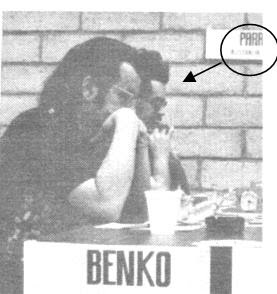
Lastly, a 29 year old Australian, David Parr is brought to your attention. The eldest son of Frank Parr, another prominent Chess Player from a chess playing family ( His brother Peter, was also of Master Strength). He played internationally for England for a few years and spent some time in Australia playing in Championships. However, he withdrew from one event in 1974 complaining “his opponents were so weak that he could not concentrate”.


Looking for strong competition, David found it at Lone Pine. In this second round victory against GM Forintos, we see an aggressive style of play for this untitled player. Popularized by Fischer at the time, the Austrian Attack was in style against the Pirc. The idea is to get quick development and control of e5. Black is allowed e5 and then Parr weakens his king side even more with a risky advance f4-f5. Black gains control of the now semi-open g-file and dark squares. Parr looks for his only hope in simplification and seizes a opportunity to exchange queens and pieces to benefit a playable endgame. Using pins and initiative, he walks his king up to a favorable position to pick up the h-pawn. The outside passer was all he needed and he gets the point.

He dies the same year as his father in 2003. There is a David Parr memorial in Australia conducted by the Correspondence Chess League of Australia in his honor.

Sunday, January 10, 2010

Lone Pine 1975: Kushnir, Tarjan and Denker, Noteworthy IM’s on the second shelf

As I dig deeper into this tournament, more interesting nuggets turn up. This post will focus on a few IM’s who had a strong finish in this event.

Alla Kushnir

Alla was the only woman IM at Lone Pines. She came over from Israel with her other Ex-Russian compatriots, Vladimir Liberzon and Leonid Shamkovich. She was the second ranking woman chess player in the world but in order to expedite her move to Israel in 1974 from the Soviet Union, she had to agree not to enter the current cycle for Woman’s World Championship. She had been the previous challenger three times against Nona Gaprindashvili. She was awarded the WIM title in 1962 and a year after Lone Pines, she earned her WGM title.

Born August 11,1941 in Moscow, this 33 year old held her ground against GM’s at Lone Pine. She Drew against GM’s Reshevsky, Csom and Robatsch and beat GM Bilek of Hungary and most notably, the upset in round one against Larry Evans. This must have been the fire lit to drive him to place second in this event.

In the game that was highlighted in the July 1975 issue of Chess Life and Review ( her photo is courtesy of that periodical), She is shown playing a very aggressive game against a Benoni. She is able to get a mobile pawn march on the e- and f- files. Larry tries to liquidate the center with a rook for a Bishop but it’s too late.


She finished Lone Pine 1975 with 5 points following 3 wins ( Silman was her third), 4 draws and only 3 loses. I could not find much else on Alla following the 70’s. She is still listed on the FIDE website with a rating of 2430 but has been inactive since as indicated by the sparce records. If anybody knows a brief epilog of where she is now, feel free to leave me a message.

James Tarjan:


James Tarjan was 23 at the time of Lon Pines and a native Californian. Five years before this event, he was selected to American Team for the World Student Olympiad. In 1974 he earned the IM title because of his strong performance in these international junior events.
At Lone Pines, he also had a strong performance. His only loss came at the mercy of Walter Browne. He beat Rhodes and Ervin, two of the USA masters. He drew the rest of his games with 5 GMs and 2 IM’s . One of those GM’s was Gligoric and I want to highlight this game.

IN round two, Tarjan played the Grunfeld as Black against Gligoric’s 1.d4. The veteran player took him down an old variation popular in Boleslavsky’s day. The game is an imbalance bishop pair versus Bishop and knight with odds favored for the bishop pair in the endgame. Gliga attempts an early queen exchange but Tarjan is allowed a strong centralized knight before White can deploy the second bishop. It’s a nice defensive endgame and worth going over.


Following Lone Pines, Tarjan wins the next event, the Western Futurity-Qualifying Tournament against a roster very similar to the masters and IMs of Lone Pine and one year after Lone Pine 1975, he received his GM title. Tarjan continues to play in several US championships in the 1970-80’s but never was quite able to pull it off. One of his strongest finishes was in Passadena 1978 where he finished in 2nd place. This was a Zonal Qualifier and he went on to play in the 1979 Riga Interzonal World Championship Cycle. His last competitive tournament was in 1984 at the U.S. Championship at Berkley where he tied for third place.

Arnold Denker:

At 61 at Lone Pine 1975, this veteran player still had some kick in him. What else can one expect from a former boxer and once rival to Samual Reshevsky and Reubin Fine? He was a U.S. Champion in 1944 and held on to it until Sammy took it back in 1946.
He became an IM in 1950 ( the first year the title was awarded by FIDE).

At Lone Pine 1975, he beats three GM’s, Rossetto, Pilnik, and Damjanovic of his four victories. He draws GM Bilek of his 3 Draws. I am disappointed in the tournament book not having any of his games annotated as the win against Rossetto is quite spectacular. In round eight, he plays a Modern Defense as Black and fights for early control of f5. This leaves a hole in the center for White to take advantage of and Denker walks right into a knight fork and loses his rook. Denker holds his ground as White waltzes into troubled waters on the King side. With a Knight and Rook, Denker threatens an unstoppable CHECKMATE! It was a beautiful win. I’m surprised it didn’t get any more recognition other than this humble blog.


He’s famous for going on and become an important chess organizer, serving on the board of American Chess Foundation, The USCF and the U.S. Chess Trust. The Denker Tournament of High School Champions is in his honor. He earned an honorary GM title in 1982, inducted into the Chess Hall of Fame in 1992, and in 2004 was proclaimed the Dean of American Chess. He died in 2005 after a brief illness. In my opinion, he is a role model for all of us chess enthusiasts.