Saturday, July 25, 2009

Zurich 1953: Efim Geller, the Trainer


Born in Odessa, in the Ukraine on March 8, 1925, would have made him 28 years old at the time of Zurich. In his youth, he was a fine basketball player and earned a Doctorate in Physical education before turning to chess. World War II delayed his development as a top chess player. It wasn’t until 1947 when he gained recognition by placing 6th at the Ukrainian Championship that his chess career started to climb. By 1949, he was making third place in the USSR championships and won a semi-qualifier. In 1951, he was awarded the title of International Master, followed by International Grandmaster a year later.

This brings us to Zurich 1953, where he qualified at Stockholm in 1952 to play in the candidates match. Geller takes on Najdorf in his familiar turf in round 13. Najdorf plays the Black side of a mainline Sicilian Defense of the variation named after him. Geller takes him into classical territories of the line with a prepared variation that was meant to offset the positional feel of the game and make use of the developmental advantage for White. The prepared line takes control of Black’s light squares and begins a queen side advance. Underestimating it’s potential, Najdorf attempts some tactical ideas of his own but Geller’s play is much deeper. He refuses the gambit pawn offer and uses it as a weakness to get a positional advantage for his knight. After the pieces are traded off, Geller demonstrates how his centralized knight is stronger than the bishop.

Geller is known for making advances in the King Indian’s defense. This is known today, but was only making some ground back in the day of Zurich. Thus, in round 17, against Euwe’s passive treatment of the once benign defense, he is overcome by Geller’s strong positional advantages.

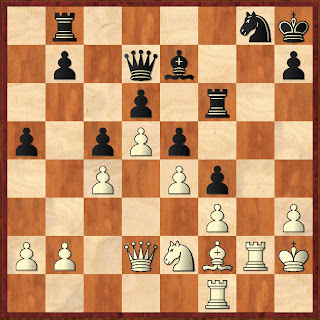
In Round 19, he shows Boleslavsky a variation of the Schevengin that transposes to Dragon like venom as he entices White to expand the pawns on the king side. Opposite side castling allows Boleslavsky to start a king side maraud. Geller decides to open up the c-file with a rook sacrifice. ( shown here)

Then he gets a couple pawns towards the endgame and is compensated enough to pull in the point.

Round 25 has Bronstein on the ropes after he admits to passive play. Another instance of opposite side castling which allowed White the opportunity of rapid development. Bronstein miscalculates and advances on the queenside and overlooks the fact that White had a bishop on g3 covering the b8 square. It allows Geller to break through and offer a rook as he gains an advanced passed pawn.

In the next round, He plays Gligoric and demonstrates how to win in an endgame with a strong initiative despite his opponent having two passed pawns. Incredible.

If that isn’t enough, in the following round ( 27), Taimanov attempts to take him down an obscure path of the Ruy Lopez with 3…Bb4. Geller’s opening knowledge and transpositional abilities plays it more like an Evan’s Gambit with tempo. This turns into a tactically sharp mêlée with Geller sacrificing two pieces to open up Black’s camp. The final position is shown here:


Bronstein’s opening comments on the game:


“ Why is it that today—as compared to ten years ago, let’s say—so few masters will go in for a fierce combinative attacks, with piece sacrifices? More than any other reason, it is because the art of combinative defense these days has reached such a high level that in the heat of the battle it occasionally becomes difficult to determine who is attacking whom.”


He places 6th with a score of 14 1/2 points.

Epilog:

His best candidates cycle was in 1962 at the Stockholm Interzonal where he finished second to Bobby Fischer. At the Candidates match he was only a ½ point short of playing for the title at Curacao, tying in second place with Paul Keres. He was known well for his openings expertise pioneering the development of the King’s Indian Defense, new variations in the Sicilian Defense and introducing the Geller Gambit in the Slav. He acted as Boris Spassky’s second for the World Championship match against Fischer in 1972, as well as acting as second for Anatoly Karpov and Tigran Petrosian.

He played strong in senior tournaments up into the 1990’s until the age of 70 where he tied for first place with Smyslov in 1991, and won clear first place in 1992.

As a side anecdote, One story he tells in his autobiography (Grandmaster Geller at the Chessboard, translated by B Cafferty 1969) is of playing in Belgrade for the Soviets against Yugoslavia. He complained that the Soviets didn't get any applause or credit for their games but in one game he was trying to find his matches in his pocket but couldn't. After a little while it became obvious to the audience what his problem was and out of the audience flew a box of matches, which he caught. That was the best applause he got.

He passed away in November of 1998 at the age of 73.

Wednesday, July 15, 2009

Blunder-Break

We'll return to our regularly scheduled chess studies after this vacation.

In the meantime, I bring you :

Bob Dylan

And....


John Mellencamp

With ...


Willie Nelson opened up the act as seen from these crappy seats before I joined the mosh pit.

Meanwhile, I'll be at the beach.


see you all next week.

Sunday, July 05, 2009

Zurich 1953: Miguel Najdorf, Master of Opening Preparation


Born near Warsaw Poland on April 15, 1910 would have made him 43 at Zurich. He took lessons from Savielly Tartakower had some early success in Warsaw during the period of 1929-through the mid 1930’s where he won the Warsaw Championship in 1935. He Won a match against his teacher, Tartakower, in the same year. He played in several Chess Olympiads for Poland.

He moved to Argentina in 1939 to escape the holocaust like other players.The Nazi killed Najdorf's whole family, including his parents, wife and little daughter. His second daughter was born in Argentina. He started playing in the Olympiads for Team Argentina. In the 1940’s he started to play in some strong international events winning ahead of some players like Paul Keres and Stahlberg.

He was never considered a chess professional. Outside of chess, Najdorf achieved a similar success in an insurance business and was one of the richest Argentinians after WWII. He owned one of the most presentable sky-scrapers in Buenos Aires.

In 1947-1948 he was ranked as the second strongest chess player but still not invited to the 1948 World Championships following Alekhine’s death. FIDE decided that only those who participated in the 1939 AVRO tournament where the late Alekhine and Capablanca had played qualified for this match.

Let’s look at the his performance at Zurch 1953. In round four, he wins a brilliancy prize against Taimanov. Taimanov had a streak of success against the King’s Indian with a new variation against the mainline that had some circles saying the opening was finally refuted. A little history about this opening that evolved about the hypermodern movement of the 1920’s didn’t start to gain so much popularity until the 1940’s when Bronstein and Boleslavsky found success with making a queen side push with pawns, opening the c-file and targeting the base of Black’s pawn chain on d6. New variations had Black advancing the pawns on the kingside in a race to break things open. Taimanov found a maneuver of his queen’s bishop to favor the solid pawn chain and dance through the dark squared holes. Meanwhile, Najdorf having suffered recent losses with the same line, took upon himself to prepare a relentless pursuit of the king side to settle the argument of the KID being “solved”. He demonstrates great precision and a relentless attack sacrificing first, a pawn then offering a Bishop to keep the initiative and pressure on the White King.


Petrosian in round 6 offers a queen exchange in a materially even position that gives him structural problems. Najdorf picks up the point with a precision.

In round 10, he takes down Stahlberg with an “uncommon Store of positional capital” ( Bronstein quote). This book orthodox QGD has Stahlberg pushing e5 with out enough preparation. Stahlberg was hoping to gradually win through his tactical acumen after exchanging down and simplifying. Najdorf banks the accumulated positional gains and goes into the endgame with: a centralized King, a more active rook, strong bishop and an active knight. There was no hope for Stahlberg.

In round 12, he plays the white side of a main line Caro-Kann against Kotov. Bronstein comments that this was the only time Najdorf played 1.e4 in the tournament, AND the only time Kotov didn’t respond with Najdorf! Perhaps then, the inexperience shows as Kotov allows the Bishop to be captured on the g6 square AFTER he castles which I found a little odd. White focuses on a queen side pawn majority as the basis for his middle game tactics. Black was overly optimistic and tried to make a run with the kingside pawn majority but the structural damage didn’t bode well.

He had a few “GM draws” in this match. One good fight was in round 15 against Paul Keres. He had the black side of a closed Sicilian defense. Keres may have been avoiding the Najdorf variation by playing Ne2 which made for a quiet line with lots of symmetry. Long story short, Najdorf picks up an extra piece towards the end but ends in a draw because of White’s advanced pawn.

He finishes with 14.5 ( 19 draws and 5 wins) points and ties for 8th place with Geller.

Epilogue:

Another player who had played Che Guevera. In a wonderful book written by Najdorf's daughter she quotes Najdorf, that this game was not drawn. Najdorf told her that in this game he had offer Che a draw and that he had not accepted it. The game had gone on and Najdorf had won. In fact Najdorf said that Che had reminded him of the other game that they had played in Mar del Plata where Najdorf won. Guevara told him that he wanted to even the score. So according to Najdorf his score against Guevara was 2-0. She goes on to quote about her father’s relationship with Che. "My father was never a communist, but he always admired Che and the Cuban revolution".

Najdorf's lively personality made him a great favorite among chess fans, helped no doubt by his aptitude for witty sayings, taking after his mentor Tartakower. An example: commenting on his opponent at the 1970 USSR-vs-World match, he remarked,


"When [then-world-champion Boris] Spassky offers you a piece, you might as well resign then and there. But when Tal offers you a piece, you would do well to keep playing, because then he might offer you another, and then another, and then ... who knows?"


Najdorf remained active in chess right to the end of his life. At age 69, he tied for second place in a very strong field at Buenos Aires 1979, with 8/13, behind winner Bent Larsen (11/13), but ahead of former World Champions Tigran Petrosian and Boris Spassky. At Buenos Aires 1988, he made a very good 8.5/15 for fourth place at age 78. The next year in the 1989 Argentine Championship, with several other GMs in the field, he tied for 4th-6th places, with 10/17. His last national championship was in 1991 at age 81, where he finished with a minus score. Najdorf was an exceptional blitz (five-minute chess) player, keeping his strength into his 80s at the quick pace. He Died on July 4, 1997 at the age of 87.

Sunday, June 28, 2009

June 2009: Behind the Scenes at BlunderLab


I’ll continue with the Zurich 1953 next post. First, I want to emphasize that I am by far, no master-level player, nor do I ever pretend to think I am. I am a chess enthusiast who puts himself in the category of adult improvement seeker. My analysis in these games are purely for exploration and discovery in this game. The more I learn, the more I understand but usually also means the longer the road becomes. Sure, I would like to be a master some day but, more importantly, I want to understand this game, its history, and human nature as to why some rocket to the top while others, try, but reach mediocre results.

Philosophically speaking: ( My journey so far)

I study the historic games and try to apply what I learn while playing. I also never claim to be a historian. I am a mere hack in comparison to Bill Wall, Ed Winter and Sarah Beth ( aka batgirl). Taking a historic tour has allowed me to no longer have that feeling of impending doom because I may not fully understand why and how a particular opening variation is played. My obstacles come from the transitions from opening to middle game and coming up with the correct plan.

When I studied the London 1851 series, the games were very dynamic but obvious. The openings had clear purpose with tactical results almost immediate with the placement of the pieces. The Hastings 1895 event built up from the swashbuckling the importance of positional play. Not only did it show me a respect for accumulations of small advantages but opening ideas around the center and pawn structures became more apparent.

The Hypermodern movement, shown moderately with the New York 1924 event, taught me that longer range planning of pieces meant a closed position could eventually open up when you least expect it. Placing bishops on long diagonals that are closed will eventually enjoy the freedom as they game open ups into the endgame. The appreciation of pawn structures for winnable endgames seemed to be more important.

The Zurich 1953 games (so far) , takes the hypermodern ideas from a quarter century prior and underscores once again, the importance of accumulating advantages while taking risks in your own position in an effort to create favorable imbalances. These nuances are advanced concepts, which require repetition and reviewing multiple games in order for me to recognize these patterns.

In all these events, I find digging for the biographical facts of the players brings to life this rich history. For me, anyways, it’s also been supplemental to creating more long term memory markers when I recall a position.

One thing I learned when I did the MDLM seven circles of hell tactical training was the visual challenge of 2D diagrams translating to three dimensional play during real tournaments. I found that I was not recognizing the same pattern presented with depth. I converted the CT-ART data base to PGN and ported it to Chess base were I can set view to 3D. It’s blocky and chunky but has helped tremendously in visual pattern recognition. Igor Foygel was the one to suggest playing the puzzles on a real board or at least converting them to 3D representation.

In that light, my chess lab ( the wife calls it my MAN CAVE), includes my laptop with a dual screen so I can feel like a mad scientist. I also have a dedicated full size set that I work through critical positions, especially where the games transition from opening to middle and late middle to endgame.

I advocate using a real tournament size set for study. Simulating near OTB experiences is critical to securing the learning process into deliverable results. I have to admit, that I was given a set by CSN distributers ( toysandgamesonline.com) by agreeing to set up a link on my blog. Long story short, they approached me because of the popularity of this blog ( thank you all for the support) and I negotiated with them and received the top end Dreuke Wooden set and board ( retails $150) all for setting a link on my blog. Call me a sell out, I don’t care. It’s my first official sponsorship! Take that Monroi!

A closer look: A lesson in two types of gambits

(I couldn't help with the microscope shot, I was aiming to tribute my blogging friend, BDK, who was also photographed beside a microscope on Transformer's post back in June of 2007)
Some folks have been asking me to post a couple of my recent games.Rather than bragging about the wins, I want to dissect a couple of my losses to underscore why my journey needs to continue .

Exhibit A, I call “Swatting at Flies” because it results in a game that I was unfamiliar and underestimated, the Benko Gambit. I’ve seen a lot of QGD and QGA, but this one surfaces later in the history tour. A poor excuse, but I have run into this and the Benoni more often lately at the club and local events. The “tabia” I knew was to advance d5 when Black plays an early …c5 without a d5 in place. But then the Benko surfaces : 1.d4 Nf6 2.c4 c5 3.d5 b5.

I know now, when in doubt, ALWAYS accept the gambit. That’s what my posthumous mentors, like Steinitz , Pillsbury, and Lasker would lead me to believe. Unless I have a prepared line, make your opponent prove the merit of the position while holding on to the extra piece. “Declining a gambit is almost unsportsmanlike ” ( Anderssen). Giving back material is always an option. In this game, I declined the gambit and played positionally.

At one point I seemed to have a rather good game until my opponent decided to open up my king side with Knight sacrifice for two of my sheltering pawns.


Like a muscle bound weight lifter trying to do yoga contortions, I could not bring my piece majority around to defend my king who was being swarmed.

The next game, I played an alchemist. I call Rumpelstiltskin because he was able to turn a rather crappy position into gold. I was on the black side of a Panov-Botvinik Caro-Kann. I started out on a quest on White’s c3. By move 12, I was ahead in development, I had his pawns fixed and a good weakness on c3 to build from. Then, I got it in my head that advancing the e-pawn was going to bring me fame and riches. In hindsight, this turns out to be an outrageous plan since White, with the bishop pair, would benefit more with an open game. By move 14 I boldly played into a bad plan. I wanted to expand e6-e5, exchange pieces. In the meantime, my opponent conjured up a Knight and Queen attack on my king. In an arrogant display of over confidence, I felt I really could walk away from it.


I think at this point I could have salvaged at least a ½ point. Instead I was spooked but the possible queen pin and dropping a piece. Greed motivated me in trying to hold on to material. I captured with the f-pawn and my game crumbled even further despite having a material advantage.

What did I learn?

In both games, the theme was around gambits. The first being more a traditional gambit pawn for piece mobility, the second, a piece gambit to gain initiative for an attack. In the game where I faced a Benko gambit, I decided a more positional challenge than sticking to basic principles. I didn’t have a prepared line and my opponent understood the nuances of the position better than I did. In the second game, I needed to give back material in order to neutralize the attack.
See you next time in Zurich 1953. It's back to the time machine as my journey continues.

Saturday, June 20, 2009

Meet Ray, He’s my dad.

In case you are wondering how I got to be such a chess enthusiast, you needn’t look much further than one click up the genealogical tree in my family. Being father’s day, I thought I’d take the time and tell you the story of Ray, my dad.

Ray grew up in a small town in Maine and was the youngest of 4 children. Since his three older siblings were much older, there weren’t many shared interests. This meant my father had to find things to entertain himself with.

Ray heard of one person in town who proclaimed to be a checkers champion who he sought to learn the game. If I recall my father’s version of the story correctly, he won the second game. Impressed with his talent ( or fearing further embarrassment), the alleged checker champion steered Ray towards a more challenging game, CHESS!

Eager to learn, Ray found a local bookstore that carried some basic chess books. With the money he made as a young teen working at the family bakery, he picked up a couple of these books to get started. He began playing with his friends and anyone who showed an interest.

He found a few friends in High school to play. He yearned for better competition and discovered Postal chess to be an answer. He’d get several cards going in the mail playing several games. This was a great period for him to hone his skills in the days before the internet and ICC.

As a young man in the late 1950’s, he was a newlywed. He found the local chess club in the city of Portland, Maine to fulfill his growing passion for the game. My mother would rather see him head off to a chess club on a Friday than hanging out in the bars, which was never the case for my dad. The only time he’d hang out in a bar was on a Saturday morning, as their bookkeeper. After all, he was a CPA.

The early years of raising a family and moving to a small town in Maine gave him limited chess options other than the postal games. I was the youngest of three. Once I reached school age, I remember him teaching my sisters to play chess. Unlike Lazlo Polgar making a psychological study out of his children, Ray merely provided us the opportunity. As I watched my oldest sister attempt her best game at dad, with knights developed off the edge of the board and nothing in the center, she was in tears by the end of the game and swore it off. I, on the other hand, was eager to dive in. I didn’t care if my pieces were taken immediately off the board. I’d only come back for more.

It was about this time in the late 1960’s that he started up a chess club in small coastal college town. The pool of players came from the local Naval base, the college and several small hamlets in the area. What amazed me was the fact that chess was the great equalizer no matter what walk of life you were.
Through our house, over the years, I’ve met plumbers, doctors, carnival workers, teachers, students, and military personnel all with a common interest in a game that lasted two millennium.

My passion for the game grew as my father’s involvement for the club grew. I was eager to come to the club, but using reverse psychology he’d say simply “ Not yet, these guys are tough. When you are ready, I’ll let you know.” Ray was patient with this exuberant youth. He started to hand me the very same books that he learned from. I recall fondly, the book by Al Horowitz, “ How to Win in the Chess Openings”. Before this, my game resembled toy football players on a vibrating table that would fall off the edge of the board. Ray, got me started down the right path by learning some basic concepts of opening play and making his copy of Chess Life and Review ( before the USCF called it Chess Life in 1980) available. He advocated playing over annotated games as the real meat to learning the game. I was naïve and wanted to simply play. But still, I was not ready for the club.

The Fischer versus Spassky match of 1972, was brought into our living room through PBS and the genius work of a couple of men, Shelby Lyman and Michael Chase. The first ever real-time American televised coverage of a world championship match was being kibitzed by my father and I in our living room with portable chess sets on our laps.

One summer day, as I played Dad handicapped by the Red sox playing in the background, I ended up not losing! The draw was my qualification to allow me to attend the weekly Club. I started going on a regular basis, even playing in team matches against other towns like Portland, Saco, and Lewiston. He encouraged me to start a chess club in the high school and even chauffeured the rag tag team to a couple matches.

Not once in my growing up did Ray ever force this game down my throat or tell me to “concentrate”, or “ how could you play such a stupid move”. These are comments, I have heard chess parents tell their kids at recent events as I watched the enthusiasm get sucked right out of these kids. Rather, he cautioned me that “ these guys at the tournaments are playing for blood.” And “ Expect to get your face rubbed in the mud by these guys ( at the club), that’s the best way to learn.” He was there for the post mortem, never shaming, always encouraging, with a “ better luck next time”.

He was there for me when I won the top student in the state in 1979. (BlunderProne shown in a vintage photo with trophy on right) Not once did he rub it in my face that there were only two of us competing for the same trophy in the Maine State Championship that year. Rather, he was proud and let me feel good about the accomplishment. He bragged to all the club members of this accomplishment. He made me feel like I was part of something special.

Then I grew up and moved out. Ray kept the club going until his retirement when it got to be too much for him to keep up. He maintains his title as Maine Chess Association’s treasurer ( to this day). I had since moved out of Maine and could not keep the club going. What did keep going was the spark of enthusiasm for this game.

I did the same for my kids, as I learned from my dad. I provide the opportunity but I don’t force it down their throats. Even though my youngest daughter loses more games than winning, she still comes back for more because she likes the same things I like about this game. The experience of meeting people of all walks of life sharing a common bond to a game that has outlasted gameboys, play stations and Frisbees.

In 2004, at a local event, a little known fact occurred that went under the radar of the local chess media. Three generations of chess enthusiasts attended the same tournament. We may not be a family of masters but we are a family of enthusiasts.
In Ray’s words:

“ The beauty of this game is that the answer is always right in front of you. It’s your mind against your opponent’s. There’s no luck, no dice to be thrown, no cards to be drawn. It’s your own fault if you lose and it’s your skill and ability if you win.”

Say hi to my dad. He lurks here and lives vicariously through my blog these days. I love him. Happy Father’s day, Dad.

Wednesday, June 17, 2009

Zurich 1953: Alexander Kotov, The tree of analysis

Alexander Kotov was born on August 12, 1913 in Tula, Russia. He was about 40 at the time of this candidates match in Zurich. He studied engineering in Moscow in 1939 but also studied a great deal of chess by then. In fact, in 1939, he almost beat Mikkhail Botvininik in the USSR Championship in the final round. The result qualified him for the title of Soviet Grandmaster, the third Soviet player to hold that very title after Botvinnik and Levenfish.

A couple more pre-Zurich matches that are noteworthy are his win as Mosco Champion of 1941; winning the Soviet title together with Bronstein in 1948; and winning in Venice in 1950 ahead of Smyslov. In 1951, he was granted the title of International Grandmaster at the age of 38! He won the interzonal in 1952 which was the pre-qualifier for the Candidates match.

A look at his games here in Zurich reveals a resourceful attacking player not afraid to mix things up a bit. In round 11 he plays White against Taimanov in a pseudo Reti/English opening. Kotov gets both of his bishops on the long diagonals while Taimanov tries for his usual Queen side grab. Missing an opportunity to free up his game and utilize a mobile pawn center, Taimanov instead locks his pieces up on the Queen side allowing Kotov to one by one migrate the entire team to an unstoppable attack on the King.

Round 10 shows a classic struggle in the Najdorf against Gligoric. White survives Kotov’s notoriously vicious Sicilian with a position that should play itself. But as Bronstein puts it, “The road to victory is a narrow path of precise moves”. Gligoric would haver faired better had he chosen the “natural” moves like Rooks on open files; then on to the 7th rank, pile up on the backward pawn, create a passed pawn then queen it. He decided to create tension in the center. Kotov, not being one to shy from a complicated game, takes the initiative, then the open files, then the occupation of the 2nd rank…and follows through with the very things White should have done. It’s a nice turn about.

Round 14 wins Kotov a Brilliancy prize against Averbakh. This is one of those games that is almost as famous as a century ago with Anderssen vs Kieseritzky. It involves a queen sacrifice of the intuitive nature. One that goes beyond, Kotov’s tree of analysis stuff. On Move 30 the following position is reached with Kotov ( Black) to move:


Bronstein comments:


The creative element in chess is generally thought to consist of three things: logic, accurate calculation and technique. There is a fourth ingredient also, however, perhaps the most intriguing of all, although it is often overlooked. I refer to intuition-chess fantasy, if you prefer.
Occasionally a position arises in the course of a game which cannot be evaluated on general principles ( pawn weakness, open files, better development), since the state of equilibrium has been upset on several counts, rendering an exact weighing of the elements impossible. Attempting to calculate the variations doesn't always work, either. ( he goes on to say:) ... It is fantasy or intuition that comes to the rescue, that has given art to chess its most beautiful combinations, and allow chess players the joy of creating....Intuitive games were not only played in the days of Morphy, Anderssen and Chigoran.
30… Qxh3! Comes out of the blue. The whole point of the sacrifice is to draw the King out to f5 where it is exposed to the two rooks, knight and Bishop while White’s other pieces sit hopeless. It’s rather beautiful.

In the next round, he beats Szabo
in a game of opposite wings castling. But, being Kotov, this is not your typical pawn storm versus pawn storm on opposite wings. Rather, both sides end up pushing pawns in front of their own kings? Why? A game with a closed center tends to have peculiarities as such. Black castled short and attempted a break on the g-file and advanced the pawns. Meanwhile, White, castling long, gets a break on the b-file and fills it with major pieces. Both sides had breakthroughs but White had the initiative.
In round 23, he beats Reshevsky when he should have lost. The game looked rather drawn for the first 28 moves with lots of maneuvers but no real targets. Boredom coupled with the desire to mix things up, makes Kotov take a risk with a pawn move that weakens a couple key diagonals ( moves the f2-f4 and now c5-g1 and a8-h1 are weak). Reshevsky over-estimates the possibilities and returns the favor to give Kotov a chance to equalize and wiggle out of complications. Like a cat, he survives the middle game and enters a knight and pawn ending with a stronger knight position. Reshevsky attempts to sacrifice his weaker knight to gain two passers but they get stopped as Kotov had his own baby queen en route.
Smyslov, as you may know, is the key player in this match ( not to spoil the series…but since the book has been around for almost 40 years… Smyslov wins). He’s almost undefeated until…. Round 21 against Kotov. Kotov plays 1.c4 and brings on a space grabbing closed position. Black recovers from the opening by liquidating the center and then advancing and fixing a pawn on White’s e4. At one point, it appears Black gets over confident and lands a knight in a way the allows Kotov to sacrifice a rook for two minor pieces. The endgame shows how the “extra material” can be of advantage. Huzzah!
In a loose translation from Kotov’s “Memoirs of a Chess Player” :

At that point, Smyslov was leading. I was somewhere in the middle of the tournament table. Reshevsky was right behind Smyslov. The reader will understand my situation: just as in Groningen, I had obstructed a colleague’s path to the supreme sporting title, without the win bringing any material improvement to my own tournament position. I understood very well the absurdity of what had happened, and that I would not get any plaudits for this win over Smyslov from my compatriots, who so closely shared in the successes of the Muscovite.

It is sufficient to say that when, as usual, I telephoned my wife in Moscow that evening, she immediately asked me:

“What are you playing at over there? I’ve had chess fans on the phone here, cursing you. Is that what you want?”

But there was nothing to be done – sport is sport! I secretly hoped that I would be able to undo some of the damage later on. I still had one more game to play against Smyslov’s main rival, Reshevsky. And so it happened. Exploiting Reshevsky’s inaccuracies, I won.

Epilog:
Alexander Kotov’s Legacy is in his writings. I think one of the most popular books is “ Think like a Grandmaster” where he talks about the tree of analysis and other ways to prune the candidate moves. What’s even more remarkable is that until that book was published, we had “handbooks” on positional play, tomes on endgames and openings, puzzle books but none really on thought processes. He had a whole series on the “Grandmaster” theme. He was a very prolific author. He died in Moscow on January 8, 1981.